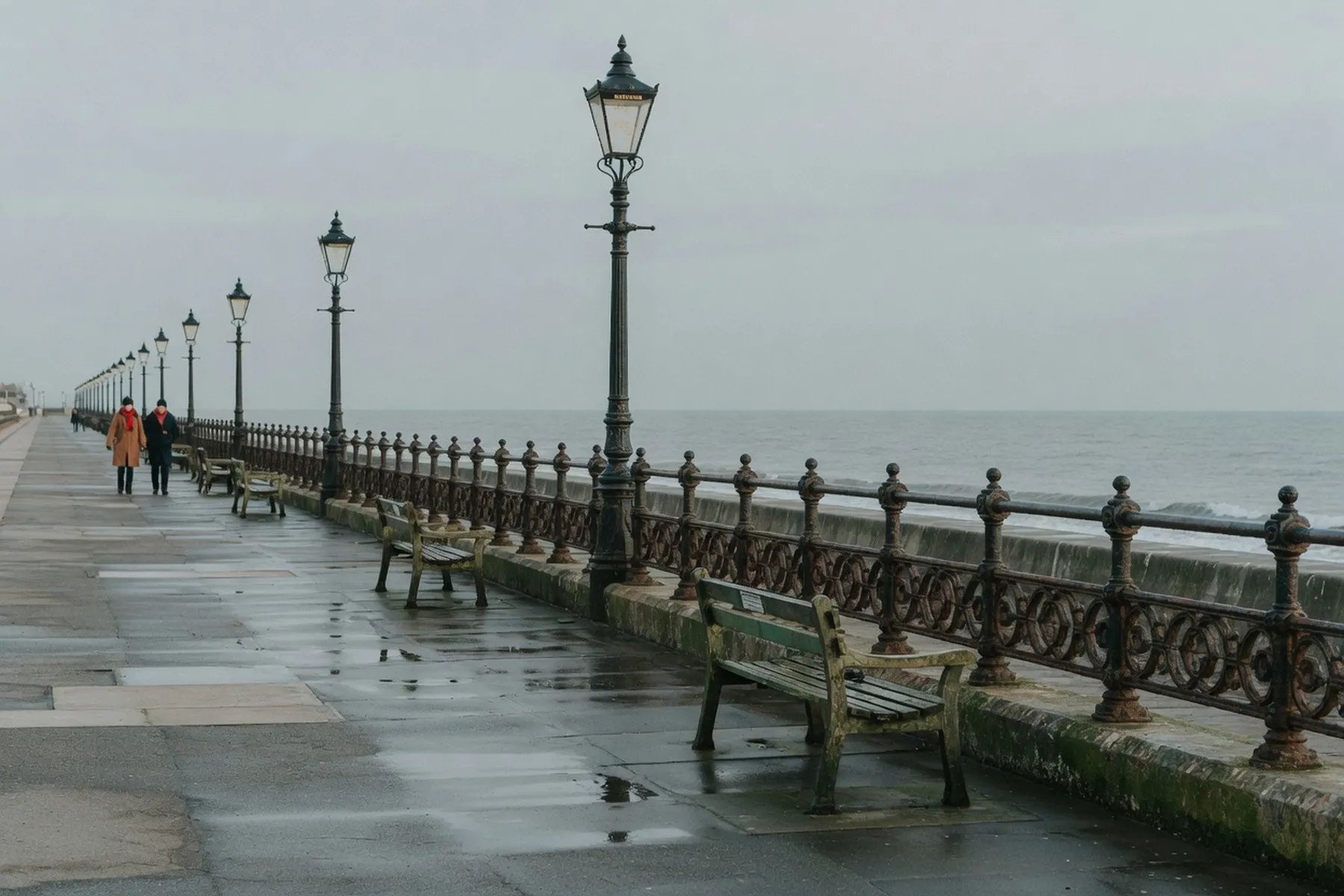
Llandudno in winter is a different town, and for most visitors a better one. The crowds are gone, the light is low and pale, and the seafront belongs to whoever has a good coat. What matters before you book is knowing which of the headline attractions actually run in the quiet months, and which December dates are worth aiming for. The tramway’s closure is the headline of both lists.
The change is most obvious on the two shores. The North Shore promenade, packed from Easter to September, empties down to dog walkers and a few wrapped-up couples, and the benches along the sea wall sit wet most mornings. West Shore is quieter still — more beach and sky than people, with the mountains across Conwy Bay coming and going in rain. It is not a closed town: the places to eat in our where to eat guide largely keep going, though individual winter hours change and it is worth ringing ahead if you are set on one place. The queues at the pier gates and the hunt for a parking space go with the summer. If you want the Victorian seafront to yourself, this is the season that gives it to you.
The headline closure is the Great Orme Tramway. Its season runs from March to early November, so through the winter the Victorian cars stay in their shed and the track is quiet; it reopens each March, and the operator’s page at greatormetramway.co.uk is where you watch for the exact reopening date. In season the tramway runs seven days a week from 10am to 6pm, closing at 5pm in March, October and November, with dogs on leads welcome and only limited wheelchair access — details that matter if you are planning a trip either side of the closure.
The other seasonal rides follow the same shape but publish their dates less reliably. The summit cable car and the Bronze Age copper mines both wind down after the summer, and their exact winter closure dates were not confirmed when this page was written — check the operator’s page before you set out. The same applies to the seafront’s summer extras, the land train, the funfair and the boat trips, whose end dates move year to year.
The one attraction confirmed as staying open is the Llandudno Snowsports Centre. It runs through the whole year, not just in ski season, and its page at jnllandudno.co.uk/opening-times carries the current session times for the slope, the toboggan run and the PermaSnow slope — read it the day you plan to go, because the centre sets its hours rather than the season. The promenade and both beaches never close; they are public space, and a winter walk along either shore costs nothing and needs no opening hours. The pier is more qualified: it is the town’s centrepiece through most of the year, but its winter hours and any Christmas Day closure were not confirmed for this page, so check the pier’s own page before you build a day around it.
With the tramway off, the Orme becomes a walking hill, and winter is its best light. The low sun of December and January sits behind the headland for much of the day and puts the north side in soft shadow, while the sea below turns grey or, on the clear days, a thin metallic blue. You get up on foot: the paths from the town and Happy Valley stay open, and Marine Drive is there to walk around the headland’s edge when the road suits you, though in high wind it is a place for care rather than ambition. The goats that are a fixture of the summit are still about in winter, usually sheltering in the lee of the walls. Our guide to the Great Orme and the walks around Llandudno carry the routes; the winter difference is that you will have them largely to yourself.
The promenade is the reason to come, and it works in the cold. The sweep from the pier toward the Little Orme takes about twenty minutes at a winter pace, with the sea on one side and the long terrace of white hotels on the other, and in December the light fails by mid-afternoon so the lamps come on while you are still walking. Dress for the wind off the bay rather than the air temperature: a still grey day can turn biting at the pier end. There are shelters along the sea wall if you need to stop, and the pier gives you a roof when the rain comes in, though its winter hours are the thing to check first. It is the same walk that is packed in August, emptied out to its essential shape.
For the genuinely wet days, the town’s indoor answer does not change with the season, and our wet-weather guide already sets it out — the museums and Conwy Castle across the water. The one caution is seasonal: the Home Front Museum does not run through the whole year, and its exact winter closure dates were not confirmed for this page, so check its site before you assume it is open. Most of the rest of the indoor town keeps going through December, but a two-minute check of a place’s own page saves a cold walk to a locked door.
Christmas in Llandudno is organised around two council-run moments, and as of early October neither 2026 date was published. The Christmas Parade is the big one: in recent years it has usually fallen on the first Saturday in December, and the Town Council’s events page still said “no events at present” when this was researched, so confirm the parade date on the council page at llandudno.gov.uk/en/events/christmas-parade before you book anything around it. The lights switch-on is expected in late November but was also unconfirmed, and its date appears on the council’s main site at llandudno.gov.uk first. Past years have turned the town centre into its one genuinely busy night of the winter, and it is worth timing a short break to catch it once the date lands.
The confirmed centrepiece is Venue Cymru’s pantomime, Sleeping Beauty, which runs from 12 December 2026 to 2 January 2027. The box office is on 01492 872 000 and group bookings on 01492 872 001, and performance times, prices and the relaxed or signed performances change year to year, so take them from the show page at venuecymru.co.uk/shows/sleeping-beauty rather than from memory. Theatr Colwyn has been reported as staging The Snow Queen from 19 December to 2 January, but that listing was second-hand when this was written — confirm it at theatrcolwyn.co.uk before you rely on it. The Christmas Extravaganza that had been planned for mid-November was cancelled in September, so do not plan around it. The rest of the winter programme appears piecemeal through November, and the two theatre sites are where the full picture forms.
The quiet months are where Llandudno repays a short break. Rooms that are hard to find in August come back on the market, and the big seafront hotels and the smaller guest houses behind them price for a town that is half empty. There are no queues for the things that are open, the restaurants seat you without a booking, and a table by the window in a seafront café is easy to hold for an hour. The trade-off is the one this page has been spelling out: some of the headline attractions are shut, and the daylight is short. For most people the trade is worth making — you give up the tramway and the funfair, and you get the town back.
Getting here in winter is the same as any other month, which is to say straightforward. Trains and buses run year-round along the coast, but winter timetables are not the summer ones, so check live times before you travel. Our car-free guide covers the two stations, the coastal buses and the 1bws day ticket in full, and the principle it sets out holds in winter: the town is compact enough that most of it closes up on foot. If you are driving, the parking guide explains the car parks, which empty out as fast as the town does.
Three winter realities shape every day, and none of them appears in a summer guide. Daylight is short: by late December the useful walking light is going by mid-afternoon, so plan the Orme or a shore walk for the middle of the day rather than the end. The tide still moves the beaches and can cut off the lower shore paths, so glance at a tide table the way you would a weather forecast. And the standing rule of a winter trip here is to check opening times before you travel: winter hours are shorter, seasonal closures are real, and a page read the day before beats a locked door after a cold walk.