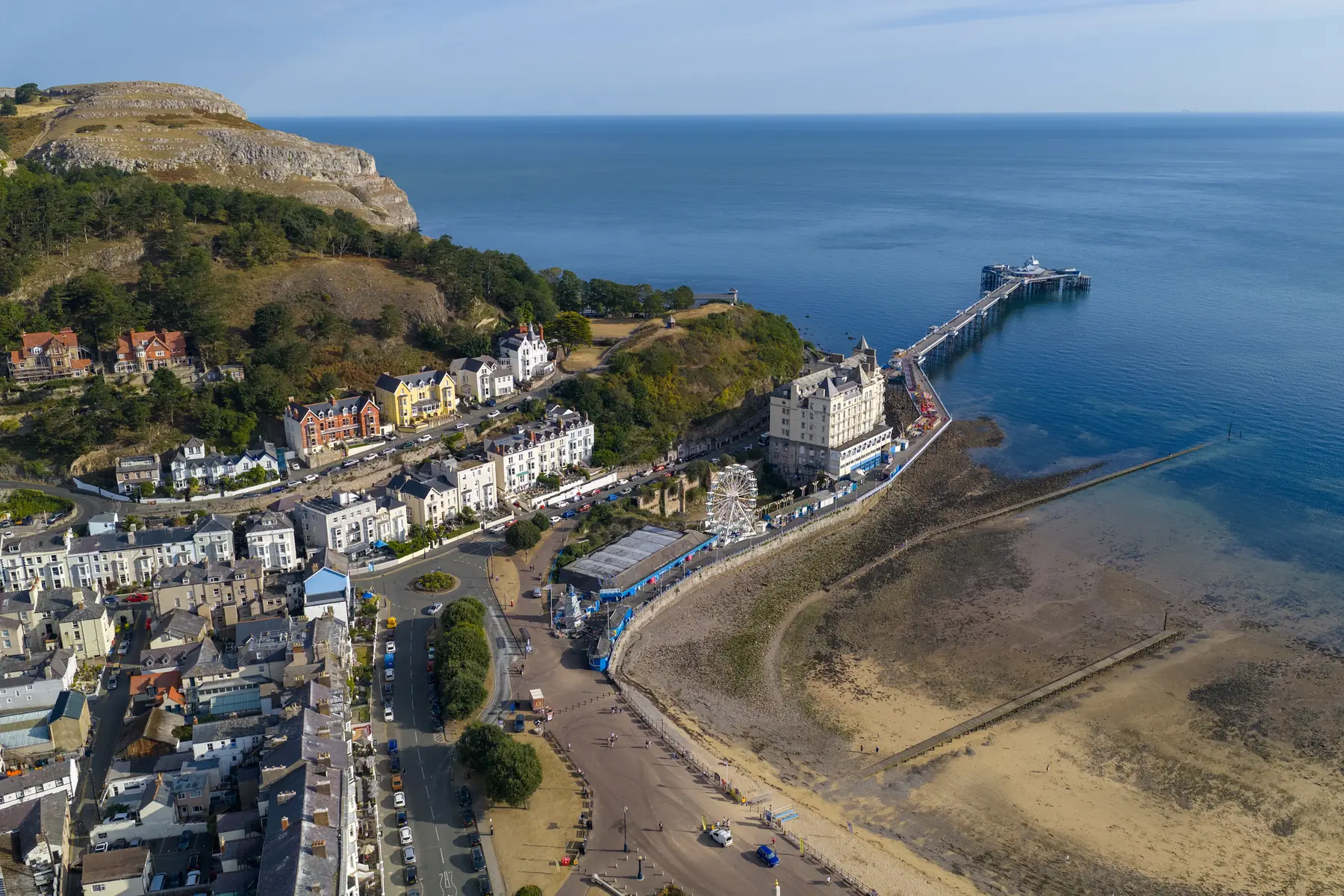
North Wales is wet. The mountains behind Llandudno wring the weather out of the Irish Sea before it gets anywhere else, and any week here should be planned on the assumption of at least a couple of days of rain.
Llandudno handles it better than most Welsh resorts because it is a full-sized Victorian town rather than a strip of seafront: there is a proper shopping street under canopies, a serious contemporary art gallery, a theatre and arena, a wartime museum, and — the trump card — a four-thousand-year-old copper mine that has never been affected by the weather in its life.
Halfway up the headland, and the single best wet-weather destination in the area. These are Bronze Age copper mines, worked around four thousand years ago and rediscovered in 1987, and they are the largest prehistoric mines open to the public anywhere in the world. Kilometres of passage have been surveyed; you walk through a section of it in a hard hat, past workings cut with stone hammers and bone tools.
An hour and a half, entirely underground, and it is the sort of visit that changes how you think about prehistory. Some passages are low and narrow.
The contemporary art gallery on Vaughan Street is Wales’s leading space for contemporary art, free to enter, with a changing exhibition programme, a shop and a café. It is a serious gallery in a seaside town and it is the best free hour in Llandudno on a wet day.
On New Street. A small independent museum recreating wartime Llandudno — shops, a street, a shelter, and a great deal of material about civilian life in the 1940s. It is well liked, it is cheap and it takes about an hour.
The theatre and arena on Mostyn Broadway carries touring drama, musicals, comedy, concerts, ice shows and one of the largest pantomimes in Wales. A matinee is the obvious answer to a wet afternoon; check the programme before you plan around it.
Grade II* listed and 700 metres long, with an arcade, food and shelter along much of its length. Being on a Victorian pier while the weather comes across the bay is a specific pleasure, and it costs nothing to walk on.
Mostyn Street is a proper Victorian shopping street with continuous glass canopies over the pavement — built in the nineteenth century for exactly this weather. You can walk most of the length of the town’s retail centre without getting wet, which is more than can be said for most resorts.
Five kilometres away. The castle is roofless, but the eight towers and the wall passages give a good deal of shelter, and the town below has the Smallest House in Great Britain on the quay, Plas Mawr — one of the best-preserved Elizabethan town houses in Britain, with painted plasterwork — and Aberconwy House, a medieval merchant’s house. Between them that is a substantial indoor afternoon.
Ten kilometres south. A garden is an odd wet-weather suggestion, but Bodnant is a valley garden of rhododendrons, magnolias and a wooded dell, and it is at its best under cloud. There are glasshouses, a shop and a café, and it is much quieter in poor weather.
Twenty kilometres west near Bangor. A vast nineteenth-century mock-Norman castle built on slate money, stuffed with furniture and paintings, with a model railway museum in the stable block. Almost entirely indoors and easily half a day.
Inland at Blaenau Ffestiniog and Bethesda, the slate industry’s leavings have been turned into underground trampolines, zip lines and cavern tours. Llechwedd and the deep mine tours are indoor by definition and are the standard North Wales wet-day escape for families with older children.
Llandudno has a Penderyn whisky distillery visitor centre with tours and tastings, which fills a wet ninety minutes agreeably.
Marine Drive around the Great Orme is tarmac the whole way and can be walked or driven; in a gale, with the sea breaking below, it is more impressive than in sunshine.
The promenade has shelters along it and the pier at one end.
Bodnant and the wooded valley walks inland have tree cover.
Avoid the open top of the Orme in low cloud — there is nothing to see and the wind is serious — and note that both the cable car and, in extreme weather, the tramway stop running.
Trains from Llandudno reach Conwy, Colwyn Bay, Bangor and Chester, which makes a wet-day escape easy without a car.
Parking in the town at the Victoria Centre, Dale Road, York Road and Maelgwyn Road; all busier when the weather is bad.
Seasonal closing. The tramway and cable car run roughly late March to late October. Several smaller attractions reduce hours in winter.
Welsh weather moves fast. The mountains make it and the coast often clears before the interior does. An hour’s patience is frequently a better plan than a long drive.
The shape that works: Great Orme Mines first thing — ninety minutes underground and the weather stops mattering entirely. Down into the town for lunch on Mostyn Street, which has continuous glass canopies over the pavements and was built for exactly this. Mostyn gallery in the early afternoon, free and indoors. Then either a matinee at Venue Cymru or the short run to Conwy for Plas Mawr and Aberconwy House, both of which are properly indoors and both of which most visitors miss.
Finish with a walk out along the pier, which is more atmospheric in weather than in sunshine.
The mountains do it. Snowdonia is the first high ground the Atlantic weather meets and it takes most of the rain out of it — which is why Llandudno, sitting on a peninsula north of the range, is drier than Betws-y-Coed twenty-five kilometres inland, and why the coast frequently clears while the mountains stay under cloud.
The practical consequence is that a bad forecast for Snowdonia does not necessarily mean a bad day in Llandudno, and if the mountains are socked in the coast is often the better bet. Look at the two separately.
Llandudno was built by Victorians who understood the weather here, and the evidence is on Mostyn Street, where continuous iron-and-glass canopies run over the pavements for most of the shopping street’s length. You can cover a considerable amount of ground without a coat, which is more than most resorts manage.
Beyond that, the pier has covered sections and an arcade; the Mostyn gallery has a café and does not charge admission; and the seafront hotels almost all have lounges and bars open to non-residents, which is a very Victorian way to spend a wet afternoon and still a good one.
If it has set in for the day, the two best moves are inland or east. Inland means the slate caverns at Blaenau Ffestiniog and Bethesda, which are underground and unaffected, or Penrhyn Castle near Bangor, which is several hours indoors. East means Chester, an hour and a quarter on the A55, with Roman walls, a cathedral and a great deal of covered shopping.
Both are better uses of a washed-out day than a third circuit of the promenade in a squall.
The Great Orme Mines underground, Mostyn gallery for free, the Home Front Museum, a show at Venue Cymru, and the covered length of Mostyn Street.
Yes, entry to the gallery is free.
Broadly, though with reduced winter hours — check before travelling.
Generally yes, in ordinary weather; it stops in high wind, as does the cable car.
The Bronze Age mines on the Orme, and Penrhyn Castle near Bangor for a longer indoor day.