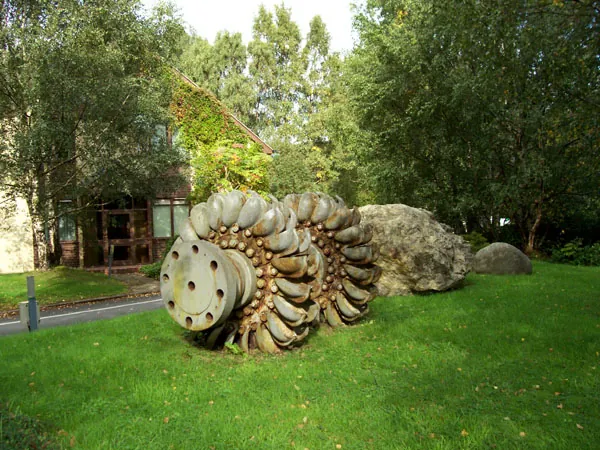
Dolgarrog is a village and community in Conwy County Borough, between Llanrwst and Conwy and very close to the River Conwy. It is small — 414 people at the 2001 census, 446 at the 2011 — and the community runs back into the Carneddau far enough to take in part of Llyn Cowlyd, so most of the parish is mountain and reservoir rather than houses. It is 14.8 km from Llandudno in a straight line, south up the valley.
Two things bring visitors. The flat ground where the aluminium works stood is now an activity site with a spa attached, and the hillside above the village is where two dams failed in 1925 and killed sixteen people. One caveat before setting off: the surf lagoon that made the site famous is no longer in use.
Surf Snowdonia, the world’s first commercial artificial surfing lake, opened on the site of the demolished aluminium factory in August 2015 and ran until September 2023. What trades there now is Adventure Parc, 4.3 from 560 Google reviews. Reviews from the past year describe high ropes, climbing walls, a ninja assault course, indoor caves, an adrenaline drop, a pump track, indoor soft play, a café and restaurant, and camping pods for overnight stays.
Do not come for the surfing. A visitor in May 2026 wrote, “We went up there to revisit this adventure park only to find out the surf lagoon wasn’t used anymore sadly. The park had been added to with zip lines and climbing indoors.”
Opinion is divided. A visitor in February 2026 managed to be fond and unimpressed at once: “Not a bad little soft play. The kids love it. The whole site feels wasted at the moment though.” One in May 2026 was blunter, calling it “Dirty, run down, awful.” Several 2026 reviews, by contrast, credit the ropes and climbing instructors by name. On the pods, a visitor in December 2025 advised, “remember to take your bedding as the pod has only a basic mattress nothing else”; a visitor in August 2026 marked the site down over dog breed restrictions, worth checking before booking.
The Wave Garden Spa on the same site rates 4.5 from 191 Google reviews: indoor and outdoor pools, sauna, steam room and treatment rooms, attached to the hotel. A visitor in July 2026 found it “a bit smaller than I expected from looking online, however it was not too busy and the key things in the spa were there”. One in September 2024 was frank about the outlook: “The surf Snowdonia outside is a bit of an eyesore.”
South of the village, Conwy Valley Maze is a hedge maze in a garden, with a small café and a list of objects to find along the way. It rates 4.6 from 109 Google reviews and is the best-liked thing here, though it is not polished: a visitor in May 2026 called it “starting to show it’s age and could do with some TLC, but still good fun to go round”. Finding it is the recurring complaint — a visitor in August 2025 warned that “it is not easy find the entry sign, and the google mark is not the right location” — and one in November 2018 advised, “Well worth a visit, just phone ahead to check that they are open.”
Coed Dolgarrog National Nature Reserve is beech and alder woodland, a combination rare in North Wales, and the beech ground supports a range of fungi in autumn. Across the valley is the crag of Cadair Ifan Goch, listed as a National Trust hiking area. Both carry only a handful of Google reviews, so their ratings mean little.
The name comes from the Welsh dôl, a water-meadow, and carrog, a torrent, and describes the place exactly: streams dropping steeply off the mountain onto flat ground by the river. Industry began in the 18th century with a flour mill on the Porth Llwyd river, a woollen mill at Dolgarrog bridge and a sawmill that exported railway sleepers. The aluminium works were planned in 1895 around hydro-electricity from the mountain reservoirs: smelting began in 1907, a rolling mill followed in 1916, and a hydro-electric plant was built beside the works in 1924.
The village largely dates from that. Before the works there was little population here, and much of the housing along the main street was built by the Aluminium Corporation, which announced a “Garden City” scheme in 1908 and also put up a hotel and a church. Smelting stopped in 1944, when Dolgarrog ingot cost nearly three times what Canadian imports did, and the plant turned to rolled and specialist products. The factory shut in late 2007 and came down in 2009. The Lord Newborough, built in the 1800s, was the village pub and later its only restaurant; it closed in September 2010 and is now a private house.
On 2 November 1925 the Eigiau Dam, a gravity dam owned by the Aluminium Corporation, failed. The water overtopped the embankment dam at Coedty below it, which failed in turn and sent the reservoir down onto the village. Sixteen people died, and many more would have had much of the village not been in the local theatre watching a film. Parliament responded with the Reservoirs (Safety Provisions) Act 1930, since replaced by the Reservoirs Act 1975.
A memorial trail was created in 2004 to explain the story to walkers and lead them to where the boulders carried down by the flood came to rest. It was opened by the last survivor, Fred Brown, who had lost his mother and younger sister that night. The scheme that caused the flood is still legible above the road: a public footpath climbs the hillside beside the pipelines, which carry water down from Llyn Cowlyd and from Coedty reservoir.
By road, the village sits on the valley road along the west side of the Conwy between Conwy and Llanrwst, with Adventure Parc directly on it.
Dolgarrog has its own station, listed with a Transport for Wales station page, but it is a halt on the far side of the river, reached by a bridge slated for closure in 2021 as structurally unsafe and reopened after repairs in 2023. The pack does not establish which trains call there or how often, so confirm the service before planning around it. It does record that the Conwy Valley train runs from Llandudno up this valley to Blaenau Ffestiniog, and that a Gwynedd Red Rover ticket covers a day’s unlimited travel on that train and on Conwy Valley buses.
Buses are less certain. A visitor in June 2021 mentioned that a bus “stops right outside”, but no route or frequency is verified anywhere in the pack, and evening services are thin: a spa visitor in May 2026 wrote, “I found I had to cut my visit a little short due to public transport ending quite early so that’s definitely to check ahead before booking”. Without a car, check the last departure before committing to the day.
The village and what is around it, at walking scale.
Open any of them in Google Maps for directions and current opening.
Want live prices and dates? GetYourGuide's booking widget shows them, and sets their cookies in your browser when it loads.
Background on Dolgarrog draws on its Wikipedia article, text there being available under CC BY-SA 4.0.