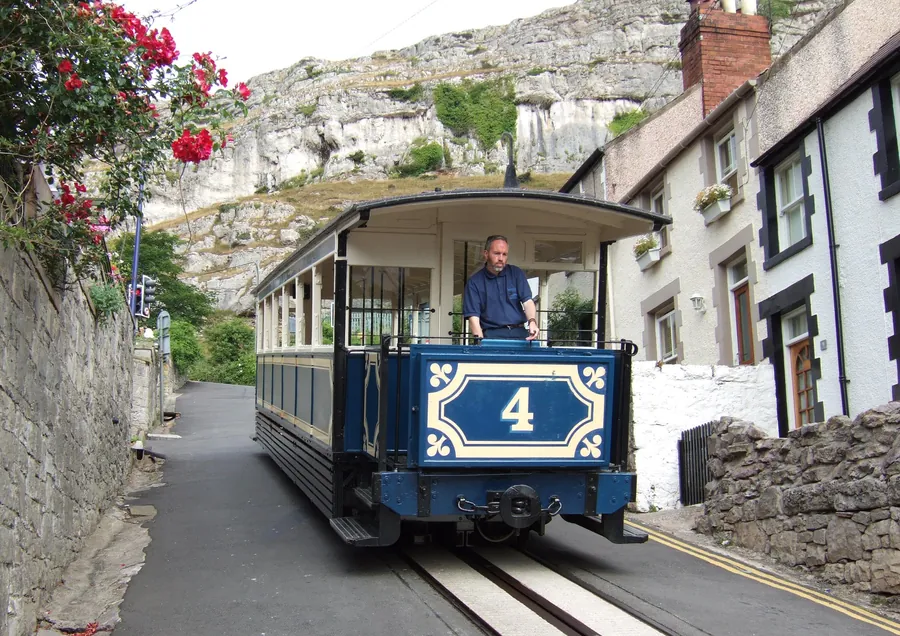
The Great Orme Tramway — Tramffordd y Gogarth — climbs from Victoria Station on Church Walks in Llandudno to just below the summit of the Great Orme, and it is one of the more remarkable survivals in British transport.
It is cable-hauled: the cars have no engines. They are pulled by a continuous steel cable running in a slot in the road, driven by a stationary winding engine — the same principle as San Francisco’s cable cars.
It opened in 1902, it runs on 3 ft 6 in gauge track, and it carries over 200,000 passengers a year.
There are only three cable-hauled street tramways left operating anywhere in the world. San Francisco has one. Llandudno has another. It is the only one in Britain.
“Street tramway” is the key phrase: the lower section runs along public roads, between houses, on ordinary streets with cars and pedestrians, at gradients up to about 1 in 4. The upper section runs on its own reserved track over the open headland.
It was known as the Great Orme Railway from 1932 and went back to its original name in 1977.
Two separate sections, with a change at the Halfway Station, where the winding house is — and where you can see the engine and the cable drums working, which is worth the pause.
The lower section climbs steeply through the streets of the old town past St Tudno’s, with the roofs of Llandudno dropping away below.
The upper section runs over grazed limestone grassland with the sea on both sides, to the Summit Complex.
The whole trip takes about twenty minutes each way. The cars are the original 1902 vehicles, restored.
The Summit Complex — a café and bar in a building that was originally the Telegraph Inn, a signal station in the chain that relayed shipping news from Holyhead to Liverpool.
The view — Snowdonia to the south, Anglesey west, the Isle of Man on a clear day, Blackpool Tower occasionally, and the whole of Llandudno below.
The Great Orme Country Park — grassland, limestone pavement, the Kashmiri goat herd that has run wild here since the 1900s, choughs, and the paths over the headland.
Great Orme Mines — the Bronze Age copper workings — are near the Halfway Station.
The cable car comes up from Happy Valley to the same summit, giving the obvious combination: up one way, down the other.
Seasonal: late March to late October. It does not run in winter.
Booking: pre-booking is strongly advised and is now the norm in peak season — visitors turning up expecting to walk on report queues and disappointment. Book online.
Fares: singles and returns; a return is better value than two singles.
Time: twenty minutes each way, plus time at the top.
Access: the cars are period vehicles with steps; check with the operator about wheelchair access.
Weather: the summit is often in cloud when the town is clear. Look up before you buy.
It is cable-hauled — the cars have no engines and are pulled by a continuous cable in a slot in the road, driven by a stationary winding engine at the Halfway Station.
It is one of only three cable-hauled street tramways left in the world, and the only one in Britain.
No — late March to late October only.
Yes, in peak season. Turning up without a booking regularly means a long wait.
Yes — the cable car from the summit to Happy Valley is the usual combination, and you can also walk down.