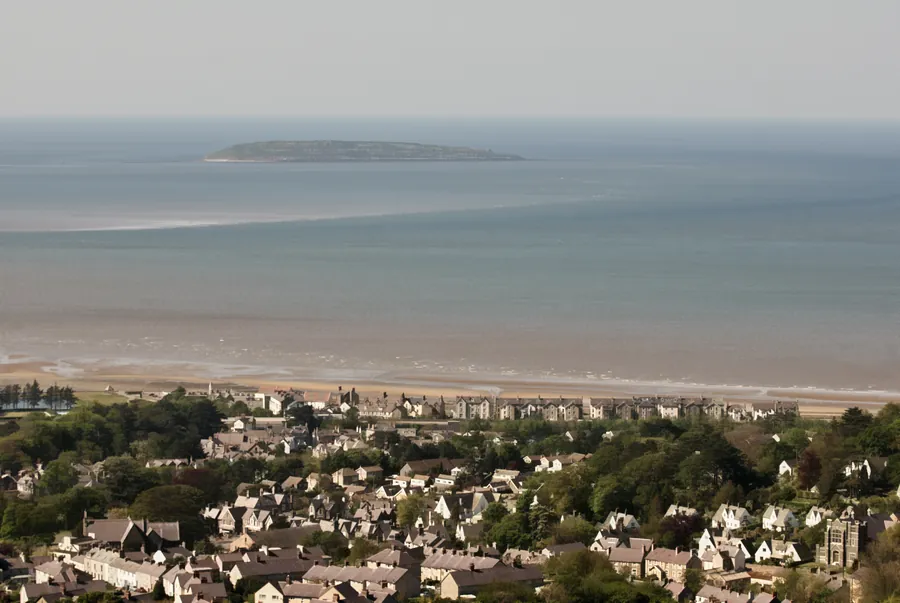
Llanfairfechan is a small seaside town on the north coast of Conwy County Borough, between Penmaenmawr and Bangor. The name is Welsh for ‘little St Mary’s parish’. It had 3,755 people at the 2001 census and 3,637 at the 2011 census, and grew from the mid-19th century onwards as two things at once: a granite quarrying town and a seaside one.
The reason to come out from Llandudno is the front: flat and open, with a promenade, a boating lake, a recreation ground and a beach that empties a long way when the tide goes out, the hills rising directly behind and Anglesey and Puffin Island across the water. A visitor to the beach in June 2026 recorded “great views of anglesey and puffin island”.
It is 12.3 km from Llandudno in a straight line, west along the coast. Expect somewhere genuinely small. The beach carries 4.6 from 863 Google reviews, but the other named places here are reviewed in single or double figures — the promenade 4.8 from 21, Victoria Gardens 4.9 from 7 — a handful of opinions rather than a verdict.
The tide shapes the visit. A visitor in June 2026 put the warning first: “Make sure you check tide times, as low tide means a very long walk to the sea!” The same review is the clearest inventory of the front: “There are public toilets in the car park, a model boat lake & kids’ play area.” When the water is out the sand is the point of the place — a visitor in July 2022 wrote that “When the tide is out, there’s miles of sand, ideal for dogs to run around.”
It cuts both ways. Another visitor in June 2026 noted that the “Tide does come in quick so be careful”, and one in April 2026 found “Not much beach as the sea was in. Very windy but we expected that with being on the estuary.”
Behind the sand is Maes Chwarae Recreation Area, 4.6 from 70 Google reviews: grass for picnics, a pond with swans and ducks, a small play area and, in summer, a paddling pool. It is dated in places — a visitor in December 2019 found “A couple of benches broken and play area is very small and dated.” The promenade appears among the family walks on the Wales Coast Path site.
There are cafés on the front rather than a run of them. A visitor in July 2026 wrote, “Very nice tearoom… the best ice-cream. Public loos are clean.” Another, in June 2026, found the “Beach Pavillion is great for quick bites & ice cream.” Dog owners should note an April 2026 visit let down by two things: “1. Public toilets were closed and 2. No dogs allowed in the cafe.”
Parking has changed, and reviews disagree because they were written either side of it. Visitors from 2021 to 2025 repeatedly describe free parking on the front. Then, in March 2026, a reviewer of the recreation area dropped to three stars over exactly that: “Great place. 3 stars as the car park has gone from free to paid.” A beach review that June reports “Ample parking, but pricey,” and a visitor in May 2026 recorded “Accessible and blue badge parking”. Anything you read about free parking here predates 2026.
West of the town, on the shore of Traeth Lafan, is Morfa Madryn: a salt marsh run by the local authority as a nature reserve and a favourite of birdwatchers, home to cormorants and shags, with the rare little egret also recorded. It is reached along the coast from the promenade — a visitor in October 2024 noted “There are bird hides overlooking the marsh,” and put the outing at “around a mile and half there and back from where I started on the Promenade.”
Inland, up Village Road, is Nant y Coed Local Nature Reserve, one of the woodland reserves Conwy council lists — 4.9, but from 15 Google reviews.
The area has been occupied a long time: a large second-century Roman milestone found here is now in the British Museum, and prehistoric sites stand on the hills above the town, the most important the old hillfort of Dinas. The 19th-century town, though, was built on granite. Hundreds of men once worked in the Penmaenmawr quarry; quarrying has now stopped completely on this side of the mountain, and Heidelberg Materials Aggregates Penmaenmawr employs about ten people there.
The resort era left one building worth knowing about. Wern Isaf, also called Rosebriars, is a house and garden designed by Herbert Luck North, an architect born in Llanfairfechan who studied in London under Henry Wilson and Edwin Lutyens before building a substantial practice in Wales. It was his own home; the house is Grade II listed and the garden listed at Grade II on the Cadw/ICOMOS Register of Parks and Gardens of Special Historic Interest in Wales.
Welsh is widely spoken here: at the 2011 census 45.3% of the population could speak it, rising to 66.2% among those born in Wales.
By road the town lies on the route of the A55, the North Wales Expressway, between Penmaenmawr and Bangor. It is in the unusual position of having only one public road connecting it to the rest of the British road network, and that is the expressway — a single point of failure a visitor met head on in July 2025: “be warned there is only one road to get back to the other side, a accident left us stranded here for 7 hrs”.
There is a railway station, on the North Wales Coast Line, close to the seafront: a visitor in July 2022 noted the “Train station right near the front.” The sources behind this page do not set out the local timetable, so check services on the day rather than assume a through train from Llandudno. Campers at Platt’s Farm on Aber Road treat the railway as usable — one in June 2026 wrote, “Easy to get train into Bangor or Conwy” — and another that month reported “Bus route to Bangor and Conwy just outside the site (number 5)”. No Llandudno–Llanfairfechan bus is documented in those sources.
The cycling link is the clearest of the three. National Cycle Network Route 5 provides a largely traffic-free, family-friendly 24-mile round trip from Llandudno to Llanfairfechan along the coast.
The village and what is around it, at walking scale.
Open any of them in Google Maps for directions and current opening.
Want live prices and dates? GetYourGuide's booking widget shows them, and sets their cookies in your browser when it loads.
Background on Llanfairfechan draws on its Wikipedia article, text there being available under CC BY-SA 4.0.