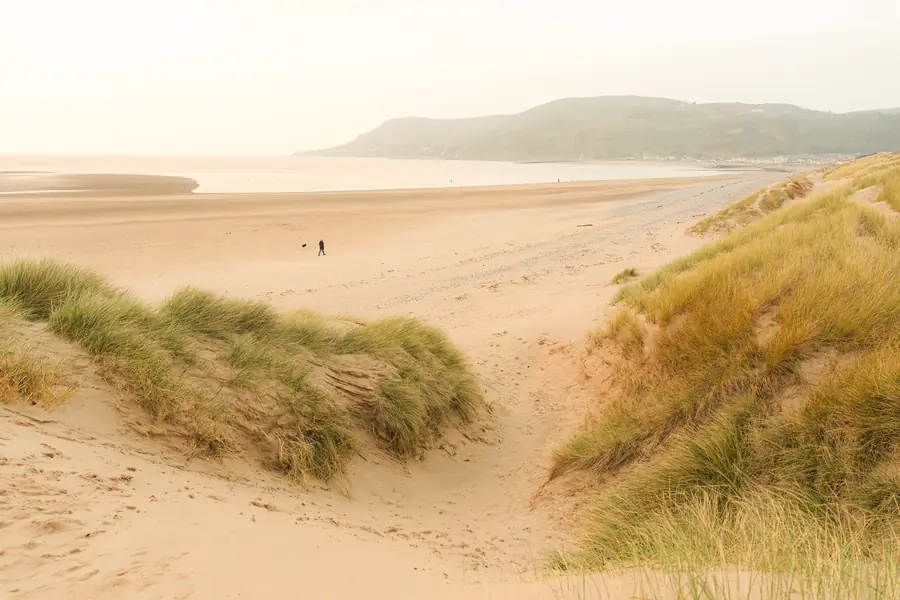
Llandudno sits on a flat isthmus between two headlands, with sea on both sides. The promenade and the pier face north-east into Llandudno Bay. West Shore faces the other way — south-west, into Conwy Bay, towards Anglesey and the mouth of the Conwy estuary.
It is fifteen minutes’ walk across the town from the pier, and it is a completely different place.
Sand and shingle, backed by dunes and a low promenade, with the Great Orme rising directly above at the northern end and the mountains of Snowdonia across the water to the south.
It is quiet. The main seafront takes almost all of Llandudno’s visitors; West Shore takes the residents, the dog walkers and the people who have worked out that the sunset happens on this side.
That contrast is the whole appeal, and visitors who use it describe it in the same terms — peaceful, atmospheric, somewhere to sit for half an hour rather than somewhere to spend a day.
Because it faces south-west, West Shore gets the evening light and the sun going down behind Anglesey and the Menai Strait. On a clear evening it is the best free thing in Llandudno.
The beach shelves gently and there is a large expanse of sand at low tide — considerably more than at high water, when the beach is mostly shingle.
There are no lifeguards. The Conwy estuary is close and there are currents; this is a paddling and walking beach rather than a swimming one, and it is not the place to let children in unsupervised.
The Liddell family — including Alice, the original of Alice in Wonderland — holidayed at Penmorfa, a house on the West Shore, in the 1860s.
There is a White Rabbit memorial on the shore, unveiled in 1933 by David Lloyd George, and the town’s Alice in Wonderland Trail runs from here. Whether Lewis Carroll himself ever came is doubted by most scholars; the Liddells certainly did.
Parking is the thing to know. There is free on-street parking along West Parade, and outside peak times there is usually a space. That is unusual for Llandudno, where the seafront is charged throughout, and it is the reason a lot of people park here and walk over the isthmus to the town.
A café near the beach provides refreshments; there is nothing like the run of facilities on the main promenade.
Toilets are available.
Dogs are generally welcome here, with fewer of the seasonal restrictions of the main beach — check the signs.
Access: the promenade above the beach is level; the beach itself is sand and shingle.
The Great Orme rises at the northern end and paths climb from West Shore to the summit and round Marine Drive.
The Wales Coast Path runs along the shore.
South, the shore leads round towards Deganwy and the Conwy estuary, with the castle and the mountains ahead — one of the best short coastal walks in North Wales.
It faces the opposite way — south-west towards Anglesey — and is far quieter, with dunes, sand at low tide and the sunset.
Yes, free on-street parking on West Parade, which is unusual for Llandudno. Outside peak times there is normally space.
There are no lifeguards and there are estuary currents nearby. It is better as a paddling and walking beach.
About fifteen minutes’ walk across the isthmus.
The Liddell family, including Alice, holidayed at Penmorfa on the West Shore in the 1860s; there is a White Rabbit memorial on the shore.