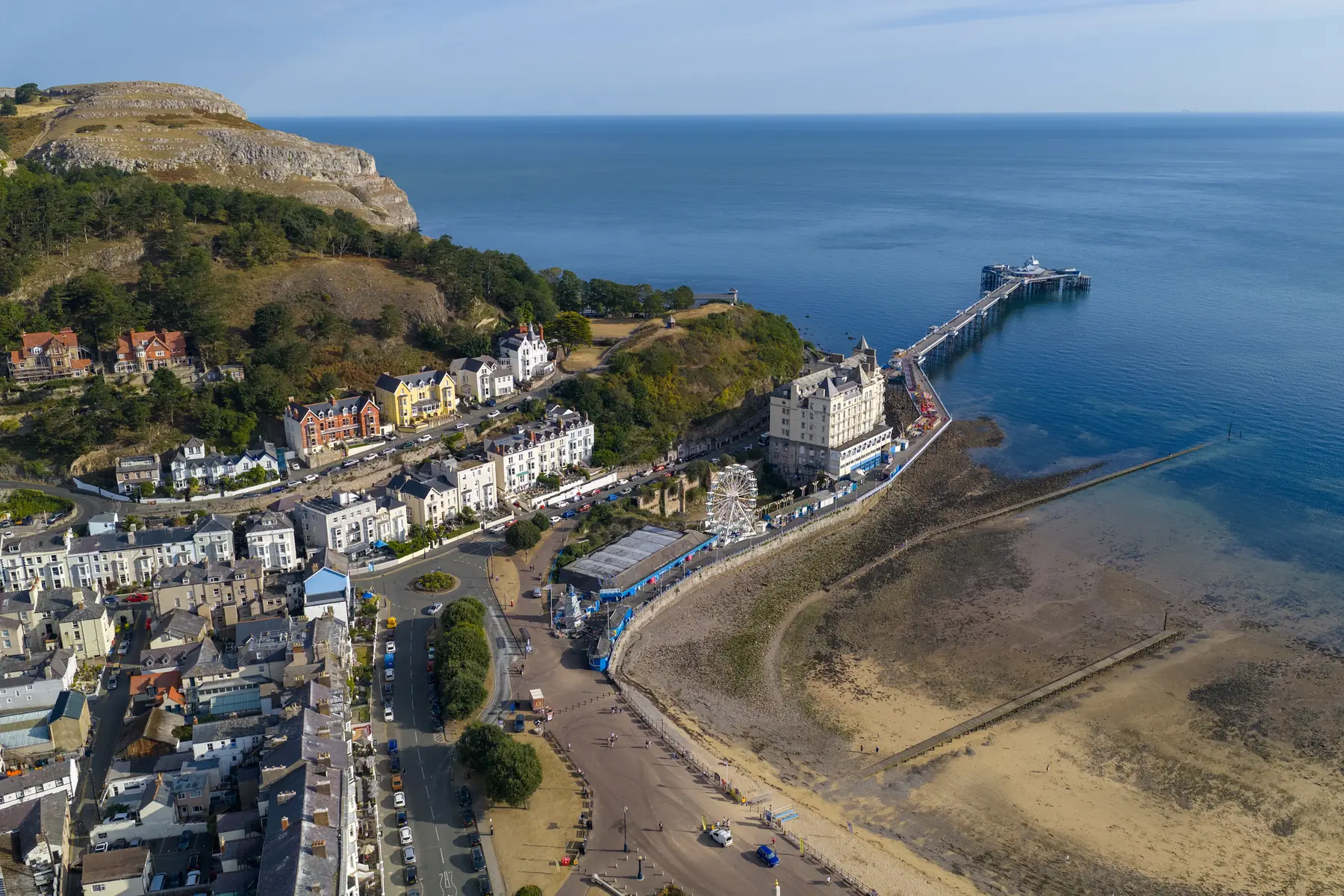
Llandudno sits on a neck of land between two limestone headlands with the sea on both sides, and that geography gives it the best town walking of any resort in Wales. The Great Orme rises 207 metres straight out of the town at one end; the Little Orme closes the bay at the other; and between them two beaches face in opposite directions, so you can watch the sun rise over one and set behind the other.
Behind all of it, the mountains of Snowdonia start about ten kilometres inland.
Distances are from the promenade.
The headland is a country park, a Site of Special Scientific Interest and the reason Llandudno exists where it does. It is limestone, it is full of caves and old mine workings, and it carries some of the rarest plants in Britain along with a population of feral Kashmiri goats descended from a Victorian gift.
The toll road that circles the Orme is also the easiest way to walk it. Marine Drive runs about eight kilometres round the headland at roughly a hundred metres above the sea, with the cliffs dropping away below and, on a clear day, the Isle of Man visible to the north.
You can walk the whole circuit from the pier in two and a half to three hours, on tarmac the whole way, with almost no climbing after the initial rise. There is a café at the halfway point near the lighthouse.
Three ways up, and one of them is walking. The tramway from Victoria Station on Church Walks is a cable-hauled Victorian tram that has been running since 1902 and carries over two hundred thousand people a year; the cable car from Happy Valley is the longest in Britain at a mile and forty feet; and the footpath from Happy Valley or from the Ty Gwyn Road climbs to the summit complex in about forty-five minutes.
Walk up and ride down, or ride up and walk down Marine Drive. Our Great Orme guide covers all three.
On the northern slope, well away from the summit complex, St Tudno’s Church stands alone on the hillside — a small medieval church on the site of the sixth-century cell of the saint who gave the town its name. Open-air services are still held beside it in summer. The walk out to it from Happy Valley across the open top of the Orme is the quietest hour on the headland.
Happy Valley, at the foot of the Orme above the pier, is a Victorian pleasure garden given to the town by Lord Mostyn in 1887 — lawns, rock gardens, an artificial ski slope and toboggan run, and the bottom station of the cable car. Haulfre Gardens, on the slope above Church Walks, are terraced and quieter with a view over the bay.
Both are free and both take half an hour.
Two kilometres of gently curving Victorian promenade between the two Ormes, backed by an unbroken crescent of hotels. It is level, it is surfaced, and walking it end to end and back is the classic Llandudno hour. Punch and Judy still performs on it in summer.
A kilometre and a half across the neck of the peninsula, the West Shore faces the Conwy estuary and Anglesey rather than the open sea. It is sandier, emptier and quieter than the North Shore, with dunes at the southern end and sunsets over Puffin Island. The walk between the two shores takes twenty minutes.
At the eastern end of the bay, the smaller headland is rougher and much less visited. A path climbs from Craigside to open limestone grassland with a view back over the whole town. Below it, Angel Bay — Porth Dyniewaid — is a cove where grey seals haul out and pup; there are usually some there, and in autumn there can be dozens.
Five kilometres south-west. The town walls of Conwy are among the most complete medieval circuits in Europe and you can walk most of them, at height, with the castle and the estuary below. Add the castle itself, built by Edward I between 1283 and 1287, and the walk out to the smallest house in Great Britain on the quay, and it is an easy half day. See our Conwy Castle page.
Behind Conwy, a ridge of open heather and rock rises to 244 metres with an Iron Age hillfort on top and a view over the estuary, Anglesey and the Carneddau. The Sychnant Pass road crosses behind it. It is proper hill walking twenty minutes from a seaside promenade, and it is a good deal quieter than the Orme.
Ten kilometres south in the Conwy valley. Eighty acres of National Trust garden dropping through terraces and a wooded dell to a river, with a laburnum arch that draws crowds in late May. Not a walk exactly, but two hours of walking within a garden.
The Carneddau — the big rounded mountains behind Llanfairfechan and Aber Falls — begin twelve kilometres west and are the least visited high ground in Snowdonia. Aber Falls itself is a straightforward walk to a thirty-seven-metre waterfall.
The tramway and cable car are seasonal, roughly late March to late October, and both stop in high wind. Marine Drive and the footpaths do not.
Parking. The Great Orme summit car park, Happy Valley and the town centre car parks all charge. There is limited free parking around the West Shore.
Trains put Conwy, Llandudno Junction, Colwyn Bay, Penmaenmawr and Bangor within easy reach for linear walks, and the branch line into Llandudno itself terminates in the middle of the town.
Wind. The Orme is exposed on all sides and the top is frequently a good deal windier than the promenade.
Goats. The Kashmiri goats on the Orme are wild animals and are best admired from a distance, particularly in the rut.
Level and surfaced: the North Shore promenade, the pier, the West Shore, and the walk between the two shores across the neck of the peninsula. All suitable for wheelchairs and pushchairs.
Level but longer: Marine Drive around the Great Orme — eight kilometres on tarmac at a constant height, with only the initial rise from the town to climb.
One steady climb: the footpath to the Great Orme summit from Happy Valley, about forty-five minutes up, with the tram or cable car available for the way down.
Rougher going: the Little Orme and Angel Bay, and the paths across the open top of the Orme to St Tudno’s Church.
A proper hill day: Conwy Mountain and the Sychnant Pass, or the Carneddau behind Llanfairfechan, which are serious mountain walking twenty minutes from the promenade.
Spring is when the limestone flora starts and the Orme is at its best botanically — this is a Site of Special Scientific Interest holding plants that grow almost nowhere else in Britain.
Summer brings the tram, the cable car and the crowds to the summit, and leaves Marine Drive and the northern slopes surprisingly quiet.
Autumn is seal season at Angel Bay, when grey seals pup on the shingle, and the rut brings the Kashmiri goats down the hillside.
Winter closes the tram and cable car but opens the headland up: Marine Drive on a clear cold day with the Isle of Man visible across the water is the best walk of the year here, and you will have it largely to yourself.
About two and a half to three hours for the eight-kilometre Marine Drive circuit, on tarmac and almost level after the initial climb.
Yes, in about forty-five minutes from Happy Valley or the Ty Gwyn Road. The tramway and cable car are the alternatives.
Angel Bay on the Little Orme, where grey seals haul out and pup. They are usually there and are most numerous in autumn.
The North Shore promenade, the West Shore, and the walk between the two across the neck of the peninsula.
Five kilometres south-west, ten minutes by road or train, with a walkable circuit of the medieval town walls when you get there.