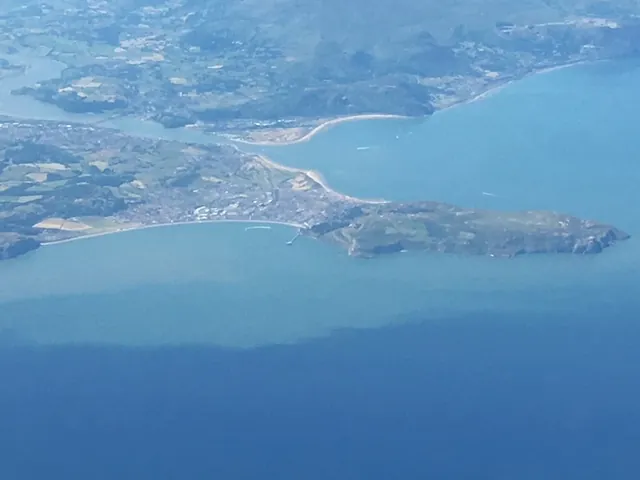
The Great Orme Mines are on the headland above Llandudno, and they are one of the most important archaeological sites in Britain — an assessment that has nothing to do with tourism and everything to do with what was found here in 1987.
Landscaping work on a car park cut into what turned out to be a Bronze Age copper mine. Excavation since has revealed at least five miles of passages on nine levels, worked from around 1900 BC for roughly six centuries.
It is the largest prehistoric copper mine so far discovered anywhere in the world.
Copper ore in the limestone was extracted using stone hammers and bone tools — the bones of cattle, used to scrape and lever out the softened rock. Over 30,000 bone fragments and several thousand hammerstones have been recovered.
There was no metal to dig with, because the whole point of the mine was to produce the metal.
The passages are very narrow in places — some so small that only children could have worked them, which is an inference the excavation makes directly and which the site does not soften.
The scale of production was large enough that Great Orme copper was almost certainly moving in the wider Bronze Age trade networks of Britain and Ireland.
The mine was reopened and worked commercially in the eighteenth and nineteenth centuries, which is when the surface workings and the later shafts date from.
An introductory film, which visitors specifically praise for setting up what follows.
The underground tour — a self-guided route through a section of the Bronze Age workings, lit, with helmets provided. The passages are original: cramped, low, irregular, and unmistakably hand-cut with stone.
The surface excavation — a large open area where the archaeology is exposed and interpreted, with the ore veins visible.
A smelting site and displays on how copper was actually produced.
Hands-on material for children.
Allow an hour and a half to two hours.
The consistent reaction is that it is far more impressive than expected — visitors arrive thinking “small local mine” and come out having stood in a 3,500-year-old workplace. Children do very well here; a seven-year-old is exactly the right age for it.
The one recurring complaint is catering: there is no proper café, only a small coffee shed, and the prices for what it sells draw comment. Bring a drink, or plan to eat in town.
Admission charged, and generally considered good value.
Time: ninety minutes to two hours.
Season: roughly March to October. Closed in winter.
Booking: advisable in school holidays, when it is busy.
Access: the underground route has low headroom, uneven floors and steps, and is not accessible. The surface excavation and visitor centre are more manageable.
Underground: cool and damp year-round; helmets provided; take a layer.
Children: the passages are cramped, which most children love and some find claustrophobic.
Facilities: toilets and a small refreshment kiosk.
On the Great Orme, about 1.7 kilometres from the town centre — a steep walk, a drive with a car park on site, or a stop on the Great Orme Tramway, whose Halfway Station is close by.
Worked from around 1900 BC, in the Bronze Age, for some six hundred years.
At least five miles of passages on nine levels — the largest prehistoric mine known anywhere in the world.
Stone hammers and bone tools. Some passages are small enough that only children could have worked in them.
The underground route is not — it has low headroom, uneven floors and steps. The surface excavation is more manageable.
Only a small refreshment kiosk, which is the site’s one common complaint. Bring your own or eat in town.