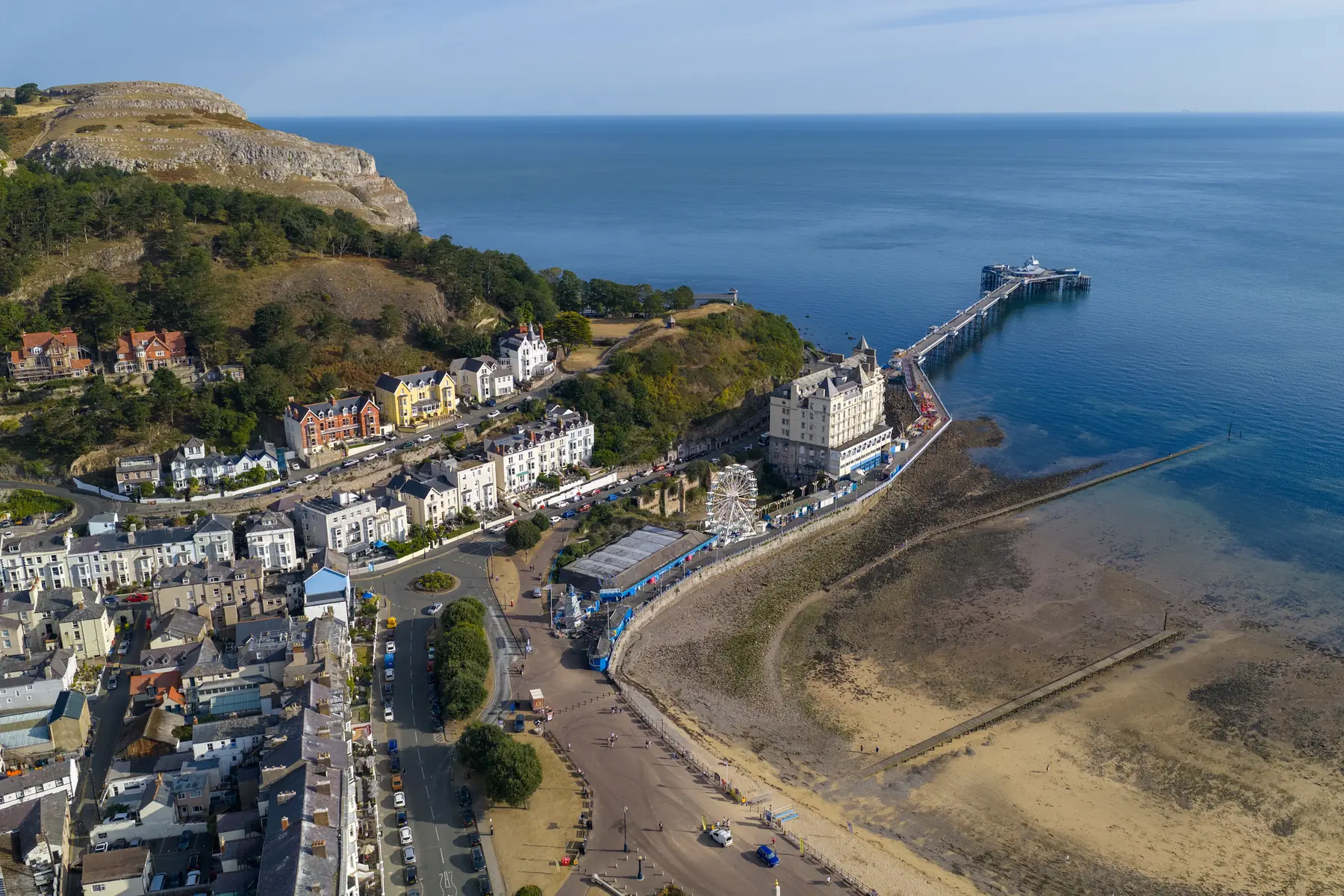
The Great Orme is a limestone headland 207 metres high that rises straight out of the western end of Llandudno’s promenade. It is the reason the town is sheltered, the reason it is where it is, and by a distance the best thing about visiting it.
It also has more ways of getting up it than any comparable hill in Britain: a Victorian cable-hauled tramway, the longest cable car in the country, a toll road round its base, and footpaths from three directions. Add a four-thousand-year-old copper mine, a colony of wild goats, a medieval church and some of the rarest plants in Britain, and it becomes clear why a headland two kilometres long can absorb a whole day.
Y Gogarth in Welsh; the English name is generally taken to come from the Old Norse for sea serpent, from the shape of the headland seen from the water by Viking sailors. The twelfth-century poet Gwalchmai ap Meilyr called it Cyngreawdr Fynydd.
The rock is carboniferous limestone, which is why the headland is riddled with caves and old workings, why the turf is full of unusual flowers, and why there was copper here in the first place.
People have lived on it since the Stone Age. There is an Iron Age hillfort at Pen-y-Dinas on the eastern slope, and the copper mines were being worked in the Bronze Age.
Opened in 1902, cable-hauled, and one of only a handful of cable-operated street tramways left anywhere in the world. It runs from Victoria Station on Church Walks, climbs through the streets of the upper town on rails set into the road, changes cars at a halfway station, and continues up the open hillside to the summit.
It runs from late March to late October and carries over two hundred thousand people a year. It is slow, it is loud, and it is one of the genuinely distinctive things to do in Wales. See our Great Orme Tramway page.
From Happy Valley, above the pier, the Llandudno Cable Car runs a mile and forty feet — 1.622 kilometres — over the eastern flank of the Orme to the summit. It is the longest cable car in Britain, the cabins are open-sided four-seaters, and the view down over the bay is the best in the town.
It is seasonal and it stops in high wind, which on this coast is a regular occurrence. Do not build the day around it without a fallback. See our Summit Cable Car page.
Forty-five minutes from Happy Valley or from the Ty Gwyn Road, on good paths, with a steady climb. Walking up and riding down is the local’s approach and the most satisfying.
The toll road that circles the base of the headland at around a hundred metres above the sea. Eight kilometres, one way for cars, and free to walk. There is a café near the lighthouse at the far side, and on a clear day the Isle of Man is visible.
Halfway up the Orme, and the reason the headland matters beyond tourism.
The Great Orme Mines were worked around four thousand years ago for copper, using stone hammers and bone tools, by people who had no metal implements to dig with. The site was rediscovered in 1987 during a landscaping scheme, and excavation has revealed several kilometres of passages on multiple levels — the largest prehistoric mine complex open to the public anywhere in the world.
You walk into it in a hard hat, along tunnels that in places are very narrow, past workings and a large opencast area, with an exhibition of finds. It takes an hour and a half, it is entirely weatherproof, and it is one of the most impressive prehistoric sites in Britain.
The summit complex is a former hotel — built in the 1900s and once owned, improbably, by the boxer Randolph Turpin — now a visitor centre with a café, a bar and a viewing terrace. On a clear day you can see Snowdonia, Anglesey, the Isle of Man, Blackpool Tower and the Lake District fells.
There is also a dry ski slope and toboggan run on the Orme’s eastern slope above Happy Valley, and a nine-hole golf course on the top.
A herd of Kashmiri goats has lived on the Orme since the nineteenth century, descended from animals given to Lord Mostyn. They are wild, they are large, they have very long horns, and they roam the headland and — when the weather is bad or the grazing is poor — the streets of the upper town, which produces a photograph in the national press every few years.
Admire them from a distance, particularly in the autumn rut.
On the northern slope, well away from the summit road, stands a small medieval church on the site where St Tudno established a cell in the sixth century. The town is named after him — Llandudno means the church of Tudno.
Open-air services are still held in the churchyard through the summer. It is a fifteen-minute walk across the top of the Orme from the summit complex and it is the quietest and most affecting place on the headland.
The Orme is a Site of Special Scientific Interest and a country park. Its limestone grassland holds plants that grow almost nowhere else in Britain, including the wild cotoneaster, which is found in only one place on earth — here.
Seabirds nest on the northern cliffs; choughs, fulmars and guillemots are all present. The silver-studded blue butterfly has a subspecies unique to the Orme. And grey seals are usually visible from Marine Drive on the north side, with a larger colony at Angel Bay on the Little Orme.
Season. The tramway and cable car run roughly late March to late October; the mines have longer but reduced winter hours; Marine Drive and the footpaths are open all year.
Wind. The cable car stops in high wind. The summit is frequently much windier than the promenade.
Parking. There is a car park at the summit and one at Happy Valley, both charged. Marine Drive is a toll road for vehicles.
Combined tickets covering the tram and other attractions are sometimes available — worth asking at Victoria Station.
Time. Half a day for the tram, summit and a walk; a full day if you add the mines.
Take the tram up from Church Walks in the morning, before the queues build — the first cars of the day are the quietest. Spend half an hour at the summit for the view and the visitor centre, then walk north across the top to St Tudno’s Church, which almost nobody does and which is the most atmospheric spot on the headland.
Come back and walk down the western side onto Marine Drive, following it round the north of the Orme past the lighthouse café with the sea below you. Rejoin the town at Happy Valley, and finish underground at the Bronze Age mines on the way back down.
That is a full day, it takes in every part of the headland, and the only thing you pay for is the tram fare and the mine ticket.
Spring is the botanical season, when the limestone grassland comes into flower and the seabirds are back on the northern cliffs.
Summer is when the tram, the cable car and the summit complex are all running and when the headland is busiest — though Marine Drive and the northern slopes stay quiet.
Autumn brings the goat rut and the seal pupping season below the cliffs.
Winter shuts the tram and the cable car but gives the best air. On a clear cold day the view from the summit takes in Snowdonia, Anglesey, the Isle of Man, Blackpool and the Lake District, and you will have the top to yourself.
By the cable-hauled tramway from Church Walks, by cable car from Happy Valley, on foot in about forty-five minutes, or by road to the summit car park.
Yes — worked around four thousand years ago and the largest prehistoric mine complex open to the public in the world.
It is one of a very small number of cable-hauled street tramways still operating anywhere in the world, and the only one in Britain.
Yes, a herd of Kashmiri goats descended from a Victorian gift. They come down into the town in bad weather.
A mile and forty feet — 1.622 kilometres — which makes it the longest in Britain.