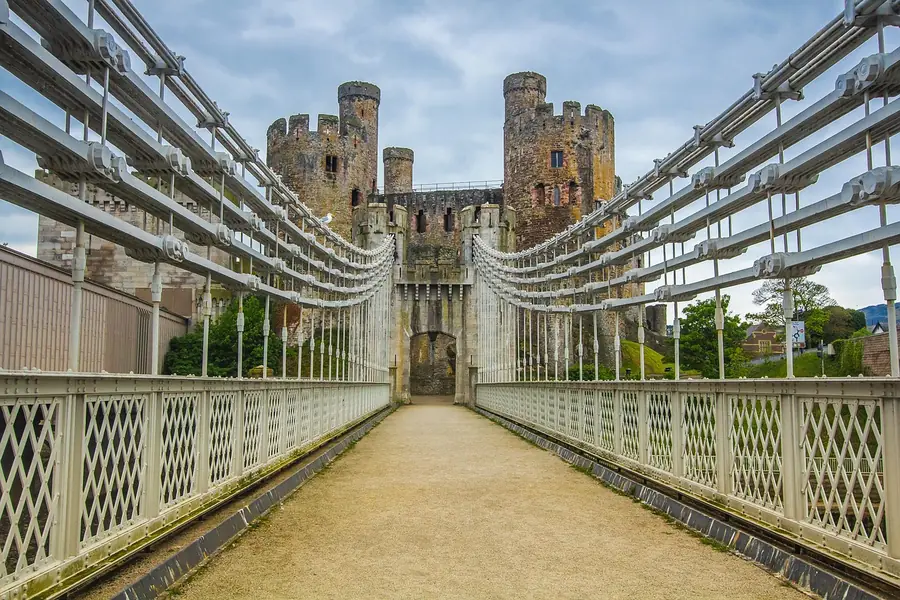
Conwy Castle stands on a rock above the estuary of the River Conwy, five kilometres from Llandudno, and it was built by Edward I between 1283 and 1287 as part of the conquest of Wales.
It is a UNESCO World Heritage Site, together with Caernarfon, Beaumaris and Harlech, and it is the most complete of the four to walk around.
The castle and the walled town were conceived as one project and built together in four building seasons — an extraordinary pace — at a combined cost of around £15,000, an enormous sum, roughly a year’s total royal revenue.
Master James of St George, the Savoyard engineer who designed Edward’s Welsh castles, laid it out to fit the rock: a long rectangle divided into an outer and inner ward, with eight great drum towers and a barbican at each end. There is no keep — the inner ward, containing the royal apartments, functions as one.
The town walls are the other half and are the point often missed. They run 1,300 metres around the town with 21 towers and three gateways, and they are almost completely intact — one of the finest sets of medieval town walls in Europe. You can walk most of the circuit, free, and the view of the castle from the walls is better than the view from inside it.
1294–95: besieged by Madog ap Llywelyn. Edward himself was trapped inside over the winter, cut off by floods and running short of food, until the fleet relieved him.
1399: Richard II sheltered here on his last journey, and it was from Conwy that he was lured out and taken by Bolingbroke’s men — the beginning of his deposition.
1401: seized on Good Friday by two cousins of Owain Glyndŵr, who took it with a handful of men while the garrison was at church, and held it for months.
1642–46: garrisoned for the King in the Civil War, besieged and taken, then slighted.
The towers and the wall walks are what people remember. The spiral staircases are original and narrow, and the tops of the towers give views over the estuary, the town, the three bridges and back to the mountains of Snowdonia.
The royal apartments in the inner ward survive as roofless shells but are unusually legible — you can read the plan of a thirteenth-century royal lodging clearly.
The Great Hall, the chapel in the Chapel Tower, and the kitchens are all identifiable.
Time: ninety minutes to two hours for the castle, longer with the town walls.
Get there early. It is one of the busiest attractions in North Wales and the towers are narrow.
Beside the castle, three bridges cross the estuary in a row: Telford’s suspension bridge of 1826, built with castellated towers to match the castle, now a footbridge in National Trust care; Stephenson’s tubular railway bridge of 1848, still carrying trains; and the modern road bridge.
Admission charged by Cadw; free to Cadw members and to English Heritage members after a qualifying period. Book online in summer.
Access: the ground level and outer ward have reasonable surfaces, and visitors comment on how manageable the footing is for a castle of this age. The towers and wall walks are spiral stairs only and are not accessible.
Getting there: Conwy station is a few minutes’ walk, on the North Wales coast line, about ten minutes from Llandudno Junction. By road it is fifteen minutes from Llandudno. Parking in Conwy is limited and busy.
The town — Conwy inside its walls is small, complete and worth a couple of hours: Plas Mawr, the finest Elizabethan townhouse in Britain, Aberconwy House, the quay, and the Smallest House.
Edward I, between 1283 and 1287, during the conquest of Wales, to a design by Master James of St George.
Yes — about 1,300 metres with 21 towers survive almost complete, and most of the circuit is walkable and free.
Ninety minutes to two hours for the castle; add an hour for the walls and the town.
The ground level is manageable; the towers and wall walks are narrow spiral stairs and are not.
Yes — Conwy station is a few minutes’ walk and is about ten minutes from Llandudno Junction.