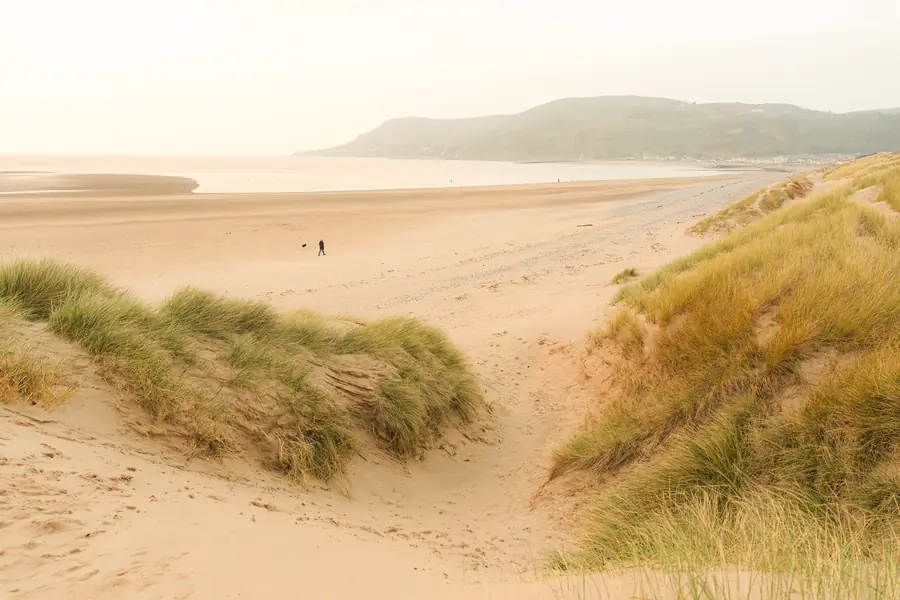
Llandudno sits on a flat isthmus with the sea on both sides. The promenade and the pier face north-east into Llandudno Bay and take almost everyone who comes. West Shore faces the other way — south-west, into Conwy Bay, towards Anglesey and the mouth of the Conwy estuary — and takes the rest.
It is fifteen to twenty minutes on the level from the pier. It is a different town. The attraction page is the short version. This is the day.
The geography is the whole appeal. The Great Orme rises at the northern end; Snowdonia sits across the water to the south; the sun goes down behind Anglesey and Puffin Island. The North Shore cannot offer that evening.
The shore is sand and shingle, backed by a low promenade and, towards Deganwy, by dunes. There is no hotel crescent, no pier, a café, toilets, a small play area, and a great deal of sky. The Mostyn plan put the resort on the North Shore. West Shore was the back, which is why it still works.
At high water you are mostly on shingle. At low tide a wide sheet of sand comes out, more than the North Shore offers. The southern end, towards Deganwy, is where the dunes are, and where the beach feels least like a resort.
The Wales Coast Path runs along here. South, the shore leads round towards Deganwy with Conwy Castle ahead. North, paths climb onto the Orme and onto Marine Drive. Wear something on your feet — the shingle is real shingle.
There are no lifeguards. That is the first thing to know, and it is the thing the North Shore’s seasonal presence can make you forget.
West Shore sits where the Conwy estuary meets the Irish Sea. The water can be shallow for a long way, which looks safe and is not the same as being safe. There are currents near the estuary mouth. The tide comes in fast over the sand, particularly on spring tides; people get cut off, and the RNLI at Conwy is used to the call. Read the signs. Check a tide table before you walk out. Do not wander to the horizon with a picnic and an assumption.
This is a paddling, walking and sitting beach, not a swimming beach in the lifeguarded sense. If you want a dip, stay close and treat the estuary end with more respect than the view suggests. Leave inflatables on the sand.
Because the beach faces south-west, it gets the evening. On a clear night the sun drops behind Anglesey and the Menai Strait, with Puffin Island in the middle of the silhouette and, in the other direction, the Orme going dark. It is the best free thing in Llandudno, and it is why people who have already done the pier still cross the isthmus at six.
Winter sunsets happen in the afternoon. Bring a coat. The low promenade does not shelter you. Sunrise happens on the other shore: the North Shore at first light, West Shore at the end, if you are up.
West Shore is also where Llandudno’s literary claim actually lives, as opposed to where it is sold.
Henry George Liddell, Dean of Christ Church, Oxford, and father of Alice Liddell, had a holiday house built here to his own specification. Penmorfa was finished in August 1862. The family used it for Easter, summer and Christmas holidays for about eleven years. Alice was nine when the house was new and in her early twenties when they stopped coming. She later wrote of “the happiest memories of Penmorfa” and of rambles over the Great Orme and among the Llandudno sand hills.
The house is gone — demolished in 2008. The plot on West Parade is an absence with a view. What is not documented, despite a century of wishing, is a stay by Charles Lutwidge Dodgson — Lewis Carroll. He told the Wonderland story to Alice on the Thames in July 1862, before Penmorfa was even finished, and his diaries do not record a Llandudno visit. The Liddells were here. Alice was here. The claim that the books were invented on this sand is a town story, not a source.
The White Rabbit memorial stands in a small garden off the parade. It was unveiled on 6 September 1933 by David Lloyd George. The sculptor was a local stonemason, Frederick Forrester; the rabbit wears the waistcoat and the watch.
The tablet states that on this shore, during rambles with Alice Liddell, Lewis Carroll was inspired to write Alice in Wonderland. The evidence says otherwise, and the memorial is still worth standing in front of. It is Grade II, it was vandalised, it was restored by Nick Elphick and put back in 2015 behind glass and steel, and it is the public marker for a house that is no longer there. Give it five minutes, then walk the sand Alice actually walked.
An Alice in Wonderland trail of sculptures — the Hatter, the Cheshire Cat, the Queen of Hearts, Tweedledee and Tweedledum, Alice herself — was put in by the Civic Society in 1990. White rabbit plaques stitch it through the centre from the Town Hall on Lloyd Street out to the 1933 memorial. Do the sculptures if you have children. Do Penmorfa’s absence and the rabbit if you want the history. They are not the same walk. St George’s Hotel, on the North Shore, put the Liddells up before Penmorfa was built.
Along West Parade there is on-street parking that the attraction page describes as free outside peak times. Treat that as something to confirm on the signs, not as a rule you can hold the council to. If the plate says pay, pay. If it says residents, move. Dale Road pay-and-display, a few minutes inland, is the charged alternative; see the parking guide. A land train runs between the two shores in summer — useful with small children, not a winter service.
The Great Orme starts at the northern end. Climb onto the headland, or pick up Marine Drive towards the lighthouse. That circuit, and the paths to St Tudno’s, are in the walks guide and the Orme piece. South is the estuary walk towards Deganwy, then Conwy — National Cycle Network Route 5 is the lined-up version. On the sand, walk out as the tide goes out, turn round with time to spare, and sit for the last of the light.
Evenings are the point, in any month with a clear sky.
Low tide is when the beach is a beach rather than a strip of stone. High tide in a crowd is when you wonder why you left the North Shore.
Dogs are restricted on the central sand between the two stone groynes from 1 May to 30 September; the rest of the beach, and the whole of it from October to April, is the usual coastal arrangement. Conwy CBC puts the maps on its Llandudno beaches page. Read the signs on the day. The ends of the beach remain the dog-walking ground in summer.
August afternoons are still quieter than the pier, which is not the same as empty. January is empty. A wet westerly blows straight in; the North Shore, in the lee of the Orme, can be the calmer promenade that day, which is the reverse of the usual advice.
Skip a long swim. Skip the assumption that Carroll sat here and invented a rabbit. Do not skip the last hour of the light. West Shore is the reason Llandudno has two seafronts, and it is the one most visitors still treat as a rumour.