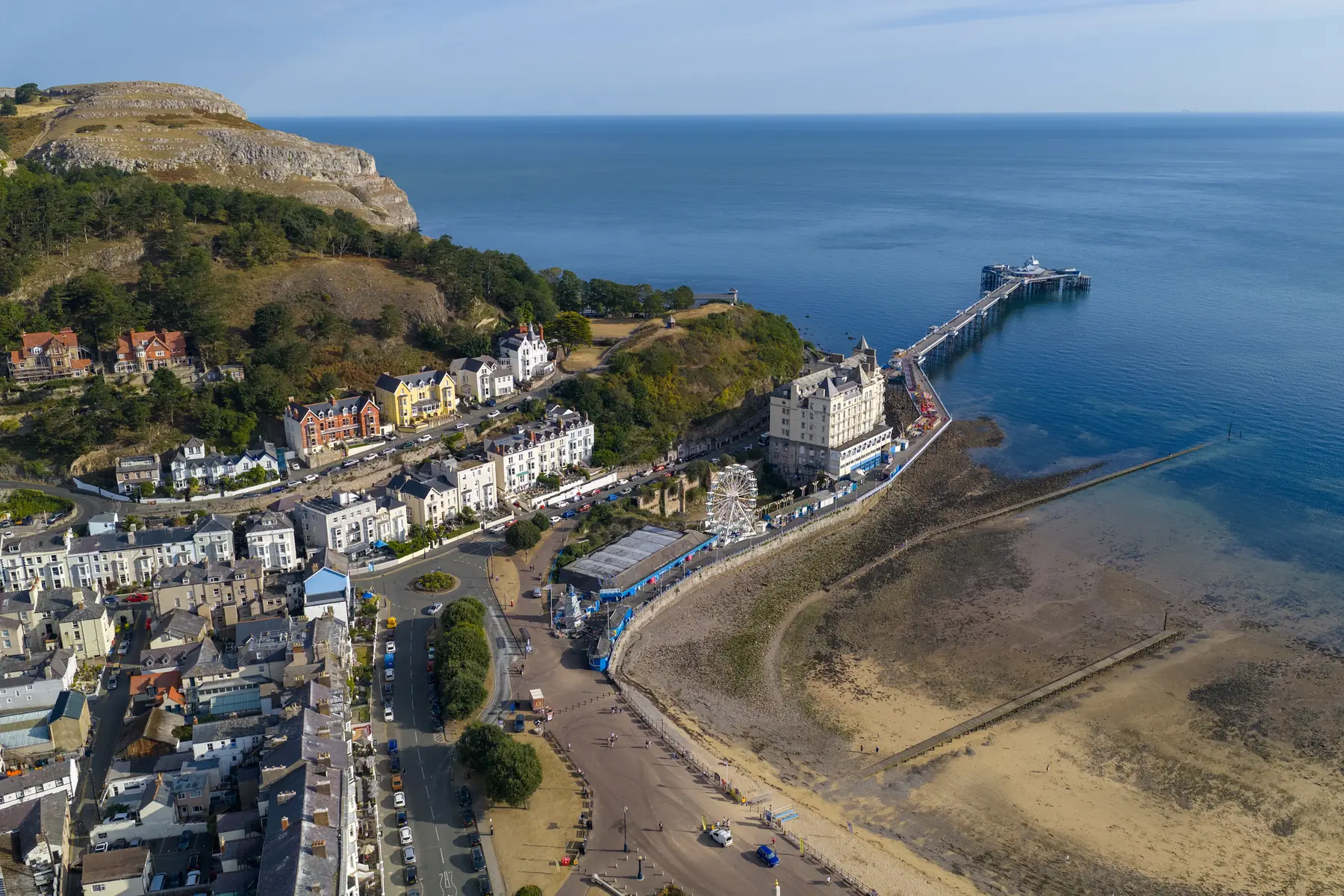
Llandudno is the best-preserved Victorian seaside resort in Britain, and that is not an accident. The town was planned from scratch in the 1850s on land belonging to the Mostyn family, laid out to a single scheme with a wide promenade, a curving crescent of hotels and strict controls on what could be built where. Those controls were maintained. The result is a seafront that looks very much as it was intended to, at a time when almost every comparable resort has been rebuilt piecemeal.
Llandudno Pier opened in 1877, is Grade II* listed, and runs 700 metres — 2,295 feet — out into the bay. It is the longest pier in Wales and the fifth longest in England and Wales, and it has twice been named Pier of the Year, in 2005 and again in 2025.
It is a pleasure pier rather than a landing stage, though steamers did once call here on the Liverpool run. Along its length are kiosks, an arcade, food, fairground rides and a bar; at the end, people fish. The ironwork is Victorian, the paintwork is white and blue, and walking out along it is free.
The pier is unusual in having a second entrance at the Happy Valley end, where a covered walkway runs back towards the Grand Hotel and the foot of the Great Orme — a legacy of the original arrangement, when the pier was designed to be reached from the baths and gardens as well as from the promenade.
See our Llandudno Pier page.
Two kilometres of gently curving seafront between the Great Orme and the Little Orme, with an unbroken sweep of hotels behind it. The Mostyn estate laid it out and controlled it, which is why there are no amusement arcades, no fast food strip and no shops on the seaward side — the same policy that shaped Eastbourne, and with the same result.
The promenade is level, wide and surfaced, with shelters, benches and gardens. Punch and Judy has been performed on it for well over a century by the same family, and it is one of the last surviving traditional seaside shows in Britain. Donkey rides run on the sand at low tide.
North Shore Beach below it is shingle at the top with sand at low water, in a long curve between the two headlands.
Twenty minutes’ walk across the neck of the peninsula is the town’s other seafront, and it could hardly be more different. West Shore faces the Conwy estuary and Anglesey, is sandier and flatter, has dunes at its southern end, and is almost empty compared with the North Shore.
It is the better beach for young children and the better place for a sunset — the sun goes down behind Anglesey and Puffin Island, which is a sight the North Shore, facing north-east, cannot offer.
The West Shore is also where Llandudno’s best-known literary claim lives. Alice Liddell — the child for whom Lewis Carroll invented the Alice stories — holidayed here with her family in the 1860s at a house on the West Shore, and the town has made a good deal of it: a white rabbit memorial on the West Shore, an Alice trail of sculptures through the town, and a long-standing local tradition that Carroll himself visited.
The historical position is worth stating carefully: the Liddells certainly holidayed here, and the house survives, but there is no reliable evidence that Carroll ever came to Llandudno himself. The town’s Alice connection is real; the claim that the stories were written here is not.
The crescent behind the promenade is the point. Large Victorian hotels — the Imperial, St George’s, the Grand at the Orme end — stand alongside a continuous run of smaller ones, most of them still hotels rather than converted flats. St George’s, opened in 1854, was the first hotel in the town and effectively started it.
Behind them, Mostyn Street is the shopping street, with continuous iron and glass canopies over the pavements — built for the weather and still doing the job.
The town has always been an entertainment resort. Venue Cymru on Mostyn Broadway is the modern version: a theatre and arena carrying touring drama, musicals, concerts, ice shows and one of the largest pantomimes in Wales. The pier, the bandstand and the seafront programme fill in the summer.
The Victorian Extravaganza over the May bank holiday brings costumed parades, a street fair and vintage transport to the town centre, which is when Llandudno looks most like itself.
Walk out to the end of the pier and back. Come along the promenade to the Grand Hotel end, cut up into Happy Valley for the gardens and the view, and either take the cable car up the Orme or walk back along the front to the Little Orme end. That is the town in miniature and it costs nothing but time.
Parking. The Victoria Centre, Dale Road, York Road and Maelgwyn Road car parks all serve the seafront; there is limited free parking near West Shore.
Getting here. Llandudno’s station is in the middle of the town, on a branch from Llandudno Junction, and the promenade is a ten-minute walk from it.
Season. The pier’s attractions, the Punch and Judy and the donkeys are seasonal; the promenade itself is year-round and is at its best on a bright winter day with the Orme white with frost.
Accessibility. The promenade and the pier deck are level throughout.
The story is worth telling because it explains everything you are looking at. Until the 1840s this was a small copper-mining and fishing settlement on the flank of the Great Orme. The land belonged to the Mostyn family, and in 1848 an Act of Parliament enclosed the marshy flat between the two headlands and allowed it to be developed.
What followed was a planned town, laid out by the surveyor Owen Williams to a scheme approved by Lord Mostyn: a wide promenade following the curve of the bay, a crescent of hotels behind it, a shopping street one block back, and a grid of streets behind that. Building leases specified what could go where, and the estate enforced them.
The railway arrived in 1858, and within twenty years Llandudno was the principal resort of North Wales. It has stayed remarkably close to its plan ever since — no seafront arcades, no high-rise, no commercial strip between the hotels and the sea — which is why architectural historians rate it as the best-preserved Victorian resort in Britain.
The two shores face opposite ways, which gives Llandudno a peculiar advantage: sunrise over the sea from the North Shore, and sunset behind Anglesey and Puffin Island from the West Shore, twenty minutes’ walk apart.
In practice, the promenade is at its best in the early morning before the day visitors arrive, and West Shore is at its best in the hour before sunset. In winter, when the Orme is white with frost and the hotels are lit along the crescent, the whole front looks like the print that sold it.
The seafront is one of the easier ones in Britain to get around. The promenade is level and surfaced for its full two kilometres, the pier deck is flat, and the town centre behind it is on the flat land between the two headlands. West Shore is reached by a level walk across the neck of the peninsula.
The climbs are all on the Orme, and both the tramway and the cable car exist precisely so that you do not have to make them.
700 metres, or 2,295 feet — the longest in Wales and the fifth longest in England and Wales.
Yes, walking onto it is free; the rides, arcade and food are not.
Because it was planned as a single scheme from the 1850s on Mostyn estate land, and the estate controlled what could be built on the seafront. That control was maintained.
No. Alice Liddell’s family holidayed on the West Shore, and the town commemorates the connection, but there is no reliable evidence Carroll visited or wrote the books here.
North Shore for the pier, the promenade and the donkeys; West Shore for sand, space and the sunset over Anglesey.