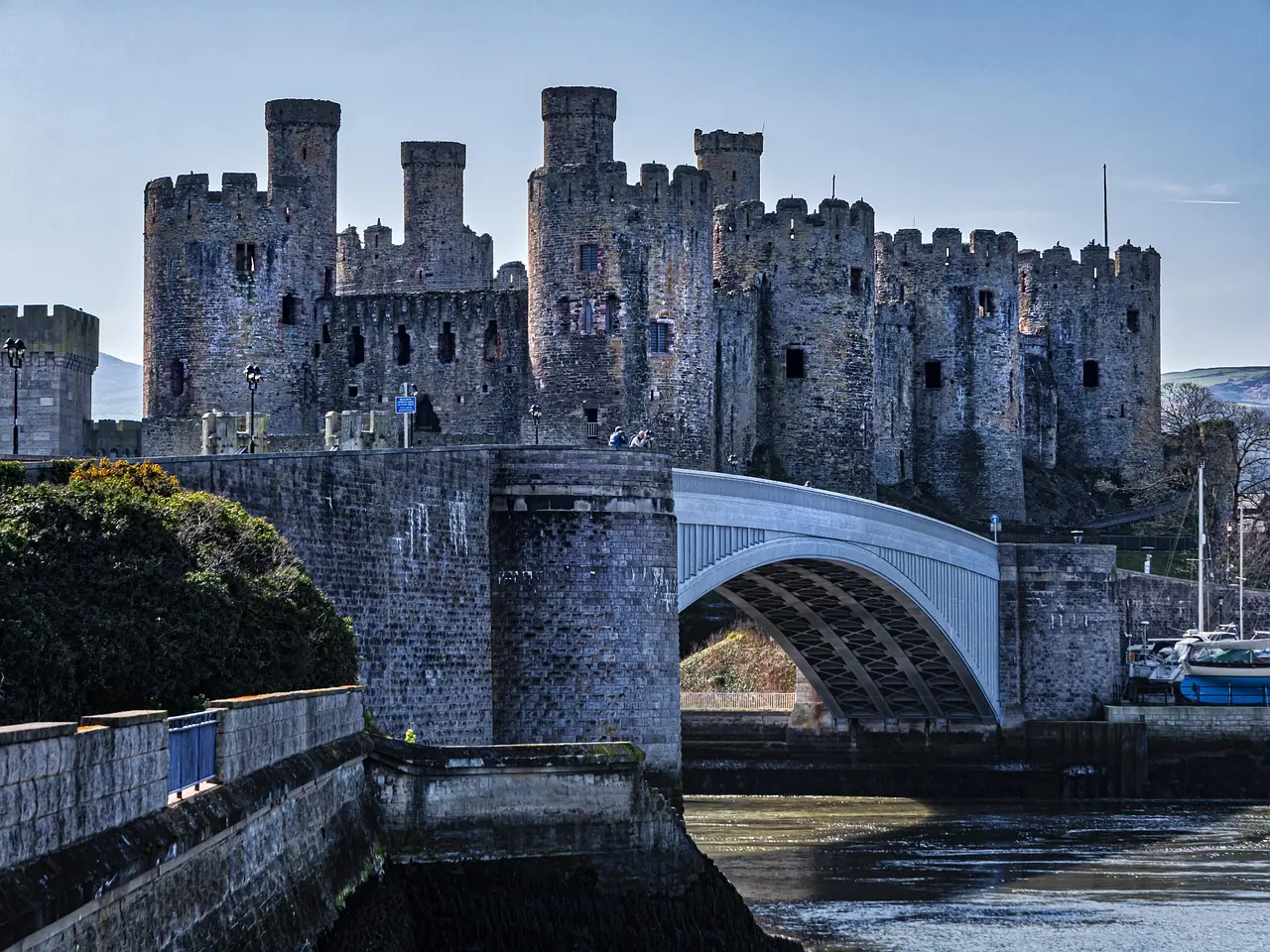
Conwy is 8 km by road from Llandudno, which is close enough that people treat it as a stop on the way to somewhere else. That is a waste of a fortress. Conwy Castle was built by Edward I between 1283 and 1287, with a walled town attached, and both survive to a degree that is unusual anywhere in Europe. The castle and the walls are a UNESCO World Heritage Site with Caernarfon, Beaumaris and Harlech. The trip from Llandudno is a castle-and-walls day, not a tick on a ring of four.
The day-trips piece puts Conwy among Snowdonia and Anglesey. This page is the day itself: how to arrive without circling the castle car park, what to climb, and how much of the town you still have after the battlements.
The castle stands on a rock above the Conwy estuary, with the walled town folded against it and three bridges in a row beside the towers. From Llandudno you can see the shape of the Orme; from the castle towers you see the Orme, the estuary, the mountains of Eryri and the harbour at your feet. That is the argument for giving it a full afternoon rather than an hour between Bodnant and the zoo.
Cadw looks after both the castle and the walls. The castle page is the monument in brief. What follows is how to use a day from Llandudno without spending the first forty minutes in a car park.
Drive if you must. Do not make the castle car park the plan.
Cadw’s own visitor centre has a short-stay pay-and-display immediately outside, with disabled bays. It is small and it fills. Vicarage Gardens on Rosehill Street is the closest park outside the walls, and it is four hours maximum, not long stay. The long-stay parks are Morfa Bach, off the B5106 Llanrwst Road, the large one with campervan bays, and Mount Pleasant. Market Place is a further option on Conwy CBC’s Conwy list. Coaches drop on Rosehill Street and park at Morfa Bach; high-sided vehicles that cannot get through the castle arch are sent to Builder Street in Llandudno.
The better ways from Llandudno do not involve any of that.
Train. Llandudno station is in the middle of town. Almost every service goes the few minutes to Llandudno Junction; Conwy is the next stop west on the North Wales Coast Line, a short hop. Confirm the day’s calling pattern — not every Junction train stops in Conwy, and Sundays are thinner. Conwy station sits inside the walls, a few minutes’ walk from the castle. Cadw puts it at about 400 metres. You come up out of a railway cutting into a medieval town. That is the correct arrival.
Bus. Cadw lists route 5, Llandudno–Conwy–Bangor/Caernarfon, as the useful service, with a stop about 200 metres from the site. Frequency changes; Traveline Cymru is the check, not a remembered timetable.
Castle and town were one project, built in four building seasons — an extraordinary pace — to a design by Master James of St George, the Savoyard engineer behind Edward’s Welsh castles. Combined cost, in the 1280s, around £15,000: roughly a year’s royal revenue.
There is no keep. The plan is a long rectangle on the rock, an outer ward and an inner ward, with eight great drum towers and a barbican at each end. The inner ward held the royal apartments, which survive as roofless shells you can still read: a thirteenth-century lodging, not a Victorian idea of one. The Great Hall, the chapel in the Chapel Tower, and the kitchens are all identifiable.
The point of standing on it is the wall-walk. Restored spiral stairs take you onto the battlements for a complete circuit of the castle, with the estuary, the three bridges, the town and the mountains in view. Cadw is not overstating it when they say there is not a better place in Britain to do that. The stairs are original, narrow and steep. If you are unsteady, the ground plan is still worth the ticket; the tops are not obligatory.
The walls are the half of the monument people drive past. They run about 1,300 metres — Cadw says 1,400 yards, three-quarters of a mile — with 21 towers and three original gateways, almost complete, one of the finest medieval circuits in Europe. You walk them at height, looking down on the streets and across to the castle, and the view of the fortress from the walls is better than the view from inside it.
They are free. That is not a rumour. The castle charges; the wall-walk does not.
They are also a historic structure, not a promenade. Cadw rates the terrain strenuous. The circuit is split into sections; you come off down modern steps and climb again. Surfaces are uneven. Dogs are not allowed on the wall-walks. Lighting is neighbouring streetlight, so winter dusk is the wrong time. A short section between the Watch Tower and the Wing Gate is closed while Cadw looks at stronger railings and mesh; they have talked about reopening around Easter 2027. That date will move if the consent does. Check the Conwy Town Walls page before you plan a full loop.
The easiest start is from the castle car park end, even if you did not park there. Walk what is open. Do not climb the stonework.
Give it ninety minutes to two hours, more if you are going up every tower. Last admission is thirty minutes before closing, which is not enough time; do not treat last entry as a plan.
Opening hours are seasonal. Cadw publishes the current table on the Castell Conwy page: longer in summer, shorter from November to February, closed 24–26 December and 1 January. Do not copy a time from a blog.
The visitor centre sits at the foot. Access into the castle is a steep path of about fifty metres with steps. Ground level is cobbled and uneven. Towers are spiral stairs, low light, historic treads. Cadw’s access guide is the document if anyone in the party needs it. Cadw’s dog policy is assistance-dogs-only from March to October.
Go early in summer. The towers are a bottleneck, and this is one of the busiest monuments in North Wales.
1294–95. Besieged by Madog ap Llywelyn. Edward himself was trapped inside over the winter, cut off by floods and short of food, until the fleet relieved him. A king of England stuck in his own new castle is the sort of detail the towers make easy to imagine.
1399. Richard II sheltered here on his last journey, and it was from Conwy that he was lured out and taken by Bolingbroke’s men — the start of his deposition.
1401. Two cousins of Owain Glyndŵr seized the castle on Good Friday with a handful of men while the garrison was at church, and held it for months.
1642–46. Garrisoned for the King, besieged, taken, then slighted. What you walk on is the ruin of that slighting as much as it is Edward’s original.
The exhibition inside will give you more. The walls give you the geography the history happened in.
Beside the castle, three crossings sit in a row, which is the postcard and also a lesson in two centuries of getting over the Conwy.
Telford’s suspension bridge, 1826, was built with castellated towers to match the castle and now carries pedestrians only, in National Trust care, free to cross. Stephenson’s tubular railway bridge, 1848, still carries the trains you may have arrived on. The modern road bridge takes the cars that should have stayed in Llandudno. The A55 itself dives under the river in an immersed tube, which is why the walled town was not demolished for a dual carriageway.
Walk Telford’s bridge. It takes ten minutes and puts the castle where a nineteenth-century traveller first saw it.
The walled town is small and complete. After the castle you still have a couple of hours if you want them.
Plas Mawr is Cadw’s other building here: an Elizabethan town house of 1576, the finest of its kind in Britain, with the painted plasterwork intact. Cadw sells a joint ticket with the castle; whether that is worth it depends on the current prices, which live on Cadw’s site, not here. If you are already a Cadw member, both are free and the joint ticket is irrelevant.
Aberconwy House, National Trust, is the surviving medieval merchant’s house. The quay has the harbour, the lifeboat station, and the Smallest House in Great Britain — three metres by not very much, lived in until 1900, ticketed, brief, and often queued. It shuts in winter. Walk past it even if you do not go in; the quay is the point.
For the rest of the town — RSPB Conwy, the Morfa, where to eat — the Conwy village page is the wider guide. This day does not need it.