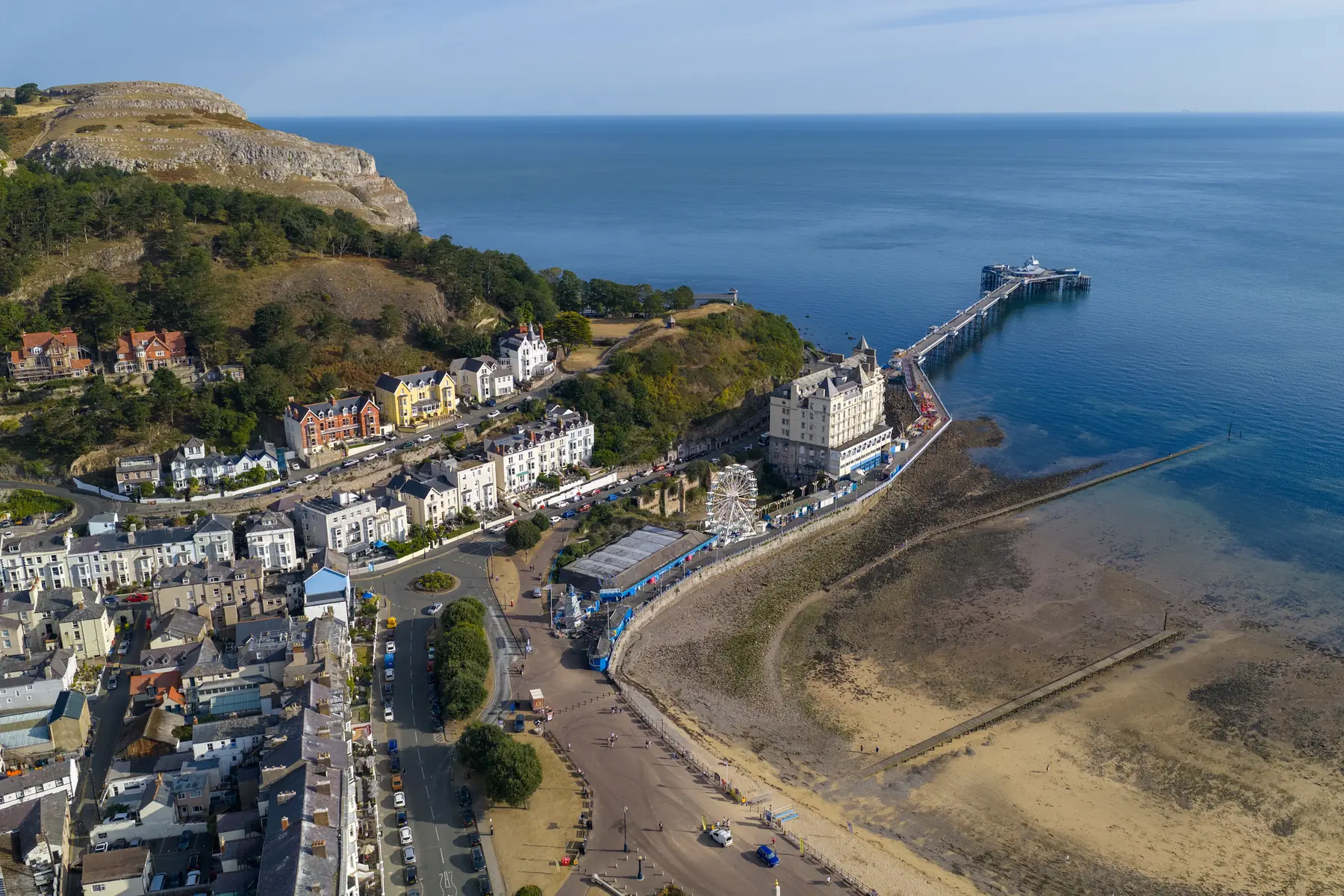
Llandudno is a better base than most people realise. Four of Edward I’s castles are within an hour. Snowdonia begins ten kilometres inland. Anglesey is across the Menai Strait. And the A55 expressway runs along the coast, which means driving here is faster than anywhere else in North Wales.
The one thing to know is that the mountain roads are slow and busy in summer — the A5 through Betws-y-Coed and the pass to Llanberis in particular — so allow more time than the map suggests once you leave the coast.
Five kilometres, ten minutes by car or train, and the essential trip.
Conwy Castle was built by Edward I between 1283 and 1287 as part of a single scheme with the walled town around it, and both survive to a degree that is unusual anywhere in Europe. The castle has eight towers and its royal apartments largely intact in outline; the town walls run three-quarters of a mile with twenty-one towers and are walkable for much of their length.
In the town below: Plas Mawr, one of the best-preserved Elizabethan town houses in Britain with its original painted plasterwork; Aberconwy House, a medieval merchant’s house; Telford’s suspension bridge of 1826 next to the castle; and, on the quay, the Smallest House in Great Britain, three metres by one and a half, which was lived in until 1900.
Half a day at least. See our Conwy Castle page.
Thirty kilometres south, forty minutes. The gateway village to Snowdonia, in wooded country where three rivers meet, with the Swallow Falls just outside, Fairy Glen, outdoor shops and a railway museum. It is busy, and it is the natural first stop inland.
Fifty kilometres, an hour. Llanberis sits below Snowdon — Yr Wyddfa — with the Snowdon Mountain Railway running to the summit, the National Slate Museum, Dolbadarn Castle and Llyn Padarn. The mountain railway needs booking well ahead in summer.
At Bethesda and Blaenau Ffestiniog, the slate industry has been turned into an adventure economy — the fastest zip line in the world, underground trampolines in a slate cavern, and deep mine tours. It is the best wet-weather day out in North Wales for older children.
Across the Menai Strait, thirty to forty kilometres west.
Beaumaris has the last and most perfect of Edward I’s castles — never finished, moated, and a masterpiece of concentric design — plus a Georgian gaol and courthouse and boat trips to Puffin Island.
Penmon Point, on the eastern tip, has a lighthouse, a priory and a view back to the Great Orme.
South Stack and Holyhead, at the far end, have seabird cliffs and a Roman fort.
The Menai bridges themselves — Telford’s 1826 suspension bridge and Stephenson’s Britannia Bridge — are worth the drive.
If you want the whole of Edward I’s Iron Ring, all four World Heritage castles are within an hour and a half of Llandudno: Conwy, Beaumaris, Caernarfon and Harlech. Caernarfon, fifty kilometres west, is the grandest — polygonal towers, banded masonry, and the town walls attached. Harlech, further south, stands on a rock above what was once the sea.
Two in a day is comfortable; four is a long day and a lot of driving.
Bodnant Garden, ten kilometres south in the Conwy valley, is one of the great British gardens — terraces, a wooded dell, a river, and a laburnum arch that draws crowds in late May. National Trust.
Penrhyn Castle, twenty kilometres west near Bangor, is a colossal nineteenth-century mock-Norman castle built on slate money, with a model railway museum. National Trust.
Bodnant Welsh Food in the same valley is a farm shop and restaurant worth a stop.
Colwyn Bay, nine kilometres east, has the Welsh Mountain Zoo on the hillside above it and a long beach.
Penmaenmawr and Llanfairfechan, west along the coast, are quiet resorts with good beaches and the Carneddau rising behind them. Aber Falls, near Abergwyngregyn, is a thirty-seven-metre waterfall reached by an easy walk.
Rhyl and Prestatyn east, and Bangor west, are the practical towns.
Portmeirion, seventy kilometres south, is Clough Williams-Ellis’s Italianate fantasy village on a wooded estuary — around an hour and three-quarters and an odd, memorable day.
Chester is ninety kilometres east on the A55, about an hour and a quarter, with Roman walls, a cathedral and the Rows.
Liverpool and Manchester are both within two hours by road and reachable by direct train.
Llandudno has its own station in the middle of the town, on a branch from Llandudno Junction where the North Wales coast main line runs. Through trains come from London Euston several times a day and from Manchester hourly on weekdays in about two and a half hours; services from Liverpool, Crewe, Cardiff and Holyhead all connect at the Junction.
From Llandudno Junction, the Conwy Valley Line runs inland through Betws-y-Coed to Blaenau Ffestiniog — one of the most scenic branch lines in Britain and the way to reach Snowdonia without driving.
Buses run frequently along the coast to Rhyl, Colwyn Bay and Bangor, and inland to Caernarfon, Llanberis and Llangollen. Routes into Llandudno itself are on the getting here page.
The castle day, by train. Conwy in the morning for the castle, the walls and the smallest house; back on the train to Bangor and on to Beaumaris by bus for the second of Edward I’s castles and the Menai Strait. Two World Heritage castles, no driving.
The Snowdonia day, by train and foot. Conwy Valley Line from Llandudno Junction to Betws-y-Coed — one of the great British branch lines — for Swallow Falls and the Fairy Glen, then on to Blaenau Ffestiniog for the slate caverns. Home the same way.
The Anglesey day, by car. Across the Menai Bridge, north to Beaumaris and Penmon Point for the lighthouse and the view back to the Great Orme, then round the coast to Moelfre or Red Wharf Bay for lunch. Slow lanes, big beaches and almost nobody about outside August.
The A55 along the coast is fast and makes the coastal trips easy. Everything inland is not: the A5 through Betws-y-Coed, the Llanberis Pass and the roads into Snowdonia queue badly in summer and at weekends, and the honeypot car parks at Pen-y-Pass, Swallow Falls and Llanberis fill by mid-morning.
If Snowdonia is the plan, start early or take the train. The Conwy Valley Line exists and is a considerably more pleasant way to get inland than the A5 in August.
North Wales gives you a real choice most days, because the coast and the mountains get different weather. Snowdonia is the first high ground the Atlantic meets and takes most of the rain out of it, which means Llandudno is frequently dry while Betws-y-Coed twenty-five kilometres inland is not — and occasionally the reverse.
Clear settled days: go inland. Snowdon, the Llanberis Pass, the Carneddau and the Conwy Valley all need visibility to be worth the drive.
Cloudy or wet days: stay on the coast or go underground. Conwy, Beaumaris, Penrhyn Castle and the slate caverns all work in any weather, and Anglesey’s beaches are often in sun when the mountains are not.
Check the mountain forecast and the coastal forecast separately; they disagree more often than not.
Conwy for a half day, Snowdonia via Betws-y-Coed for a full one, Anglesey and Beaumaris if you want a castle and a boat.
About fifty kilometres to Llanberis, an hour by road. The Snowdon Mountain Railway runs from there and needs booking ahead.
Yes, on the Conwy Valley Line from Llandudno Junction — one of the most scenic branch lines in Britain.
Two comfortably — Conwy and Beaumaris, or Conwy and Caernarfon. Four is a long day.
Yes, and late May for the laburnum arch is when it is at its most spectacular and most crowded.