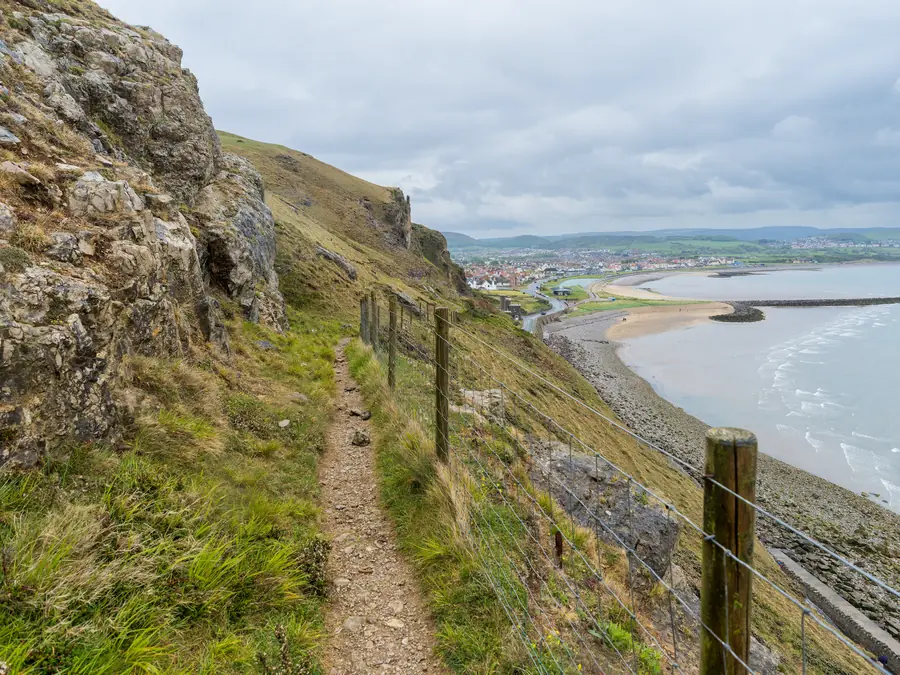
The Great Orme — Y Gogarth — is the limestone headland at the western end of Llandudno, rising to 207 metres and running out into the Irish Sea.
The name is Norse: orm, sea serpent, which is what it looks like from a boat. The twelfth-century poet Gwalchmai ap Meilyr called it Cyngreawdr Fynydd.
It is a Country Park, a Site of Special Scientific Interest and a Special Area of Conservation, covering about 300 hectares, and it is free and open.
Limestone grassland and pavement — the reason for the designations. The thin alkaline soil over carboniferous limestone supports a flora found in few other places: wild cotoneaster, which grows nowhere else in Britain and is one of the rarest plants in the country, alongside spring squill, bloody crane’s-bill and several orchids.
Silver-studded blue butterflies in a distinctive local subspecies, and grayling.
Choughs — the red-billed crow, scarce in Britain — breed on the sea cliffs, along with fulmars, guillemots, razorbills and kittiwakes. The cliffs are among the best seabird sites in North Wales.
The Kashmiri goats. A herd of feral goats has lived on the Orme since the early 1900s, descended from a pair given to the Mostyn family and ultimately from stock presented to Queen Victoria by the Shah of Persia. They are large, white, long-horned and entirely unbothered by people. They come down into the town in bad weather and occasionally make the national news for it.
On foot — paths climb from Happy Valley, from the town and from the West Shore. The summit is a stiff walk from sea level.
Marine Drive, the toll road round the base of the headland, is a one-way five-mile circuit with cliff scenery, a chapel and a lighthouse. It is also walkable and cyclable.
The Great Orme Tramway from Victoria Station.
The cable car from Happy Valley.
The open-top tour bus in season.
Most people go up one mechanical way and walk some of it.
The Summit Complex — café and bar, in the former Telegraph Inn, with a well-liked café.
St Tudno’s Church, a sixth-century foundation rebuilt in the twelfth and fifteenth centuries, on the northern slope. Open-air services are held here in summer. Llandudno is named after it.
The Bronze Age copper mines, 3,500 years old.
The visitor centre with information on the geology and wildlife.
Ancient field systems, hut circles and a Neolithic burial chamber.
Some visitors have raised concern about smoke from the mining site affecting the headland’s air. In practice the interpretive braziers and demonstrations there are small-scale and occasional; the Orme’s air is, on any ordinary day, the cleanest thing about Llandudno.
Free and open at all times; Marine Drive is a toll road and the tramway, cable car and mines charge.
Time: an hour for the summit; half a day to walk properly.
Facilities: café and toilets at the summit and at the visitor centre.
Exposure: it is a headland facing the Irish Sea. It is windy and often in cloud when the town is clear.
Underfoot: limestone grassland — grippy when dry, slippery when wet. The cliff paths have real drops.
Dogs: welcome, on leads near livestock and the goats.
Orme is Old Norse for sea serpent, which is the headland’s shape from the sea. The Welsh name is Y Gogarth.
Yes — a feral Kashmiri herd descended from stock given to the Mostyn family in the nineteenth century. They have lived on the Orme since the early 1900s.
Yes, the country park is free and open. Marine Drive is a toll road, and the tramway, cable car and mines charge separately.
On foot, by the tramway, by cable car, by the tour bus, or by car up Marine Drive and the summit road.
Rare limestone grassland flora — including wild cotoneaster, found nowhere else in Britain — plus breeding choughs and seabirds.