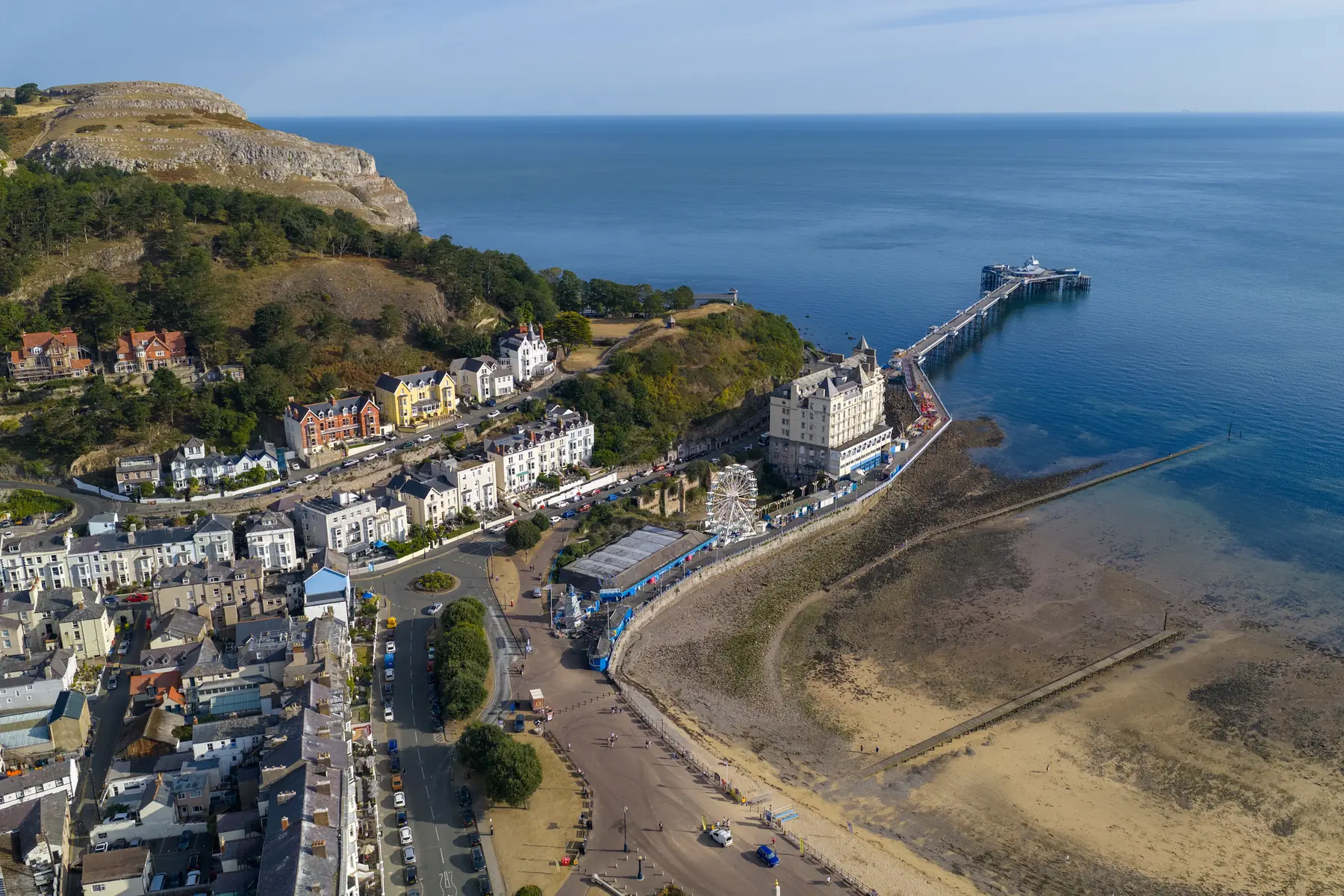
Llandudno was built as a resort for people to walk about in, and walking about is still free. The promenade, the pier, the two beaches, the whole of the Great Orme, two Victorian gardens and the best contemporary art gallery in Wales all cost nothing, and the paid attractions — the tram, the cable car, the mines — are extras rather than the main event.
The promenade curves for two kilometres between the Great Orme and the Little Orme, backed by an unbroken crescent of Victorian hotels. It is level, surfaced and one of the finest seafronts in Britain, largely because the Mostyn estate that built the town controlled what could be put on it. There are shelters, benches and, in summer, Punch and Judy, which has been performed on this promenade for well over a century.
Llandudno Pier is free to walk onto — Grade II* listed, 700 metres long, the longest in Wales and the fifth longest in England and Wales, and twice named Pier of the Year.
North Shore Beach below it and West Shore Beach on the other side of the peninsula are both free, and both are twenty minutes apart on foot.
The whole headland is a country park and it is open. That gives you:
Marine Drive, the eight-kilometre road round the Orme at a hundred metres above the sea — free to walk, tolled to drive. On a clear day the Isle of Man is visible.
The summit, reachable on foot in about forty-five minutes from Happy Valley, with views over Snowdonia, Anglesey and the whole North Wales coast.
St Tudno’s Church, alone on the northern slope, on the site of the sixth-century cell of the saint the town is named after. Open-air services are still held beside it in summer.
The Kashmiri goats, descended from a Victorian royal gift, which wander the headland and sometimes the town.
Limestone flora — the Orme is a Site of Special Scientific Interest with plants found almost nowhere else in Britain, including a wild cotoneaster that grows in only one place on earth.
Happy Valley, at the foot of the Orme above the pier, was given to the town by Lord Mostyn in 1887 and is a free Victorian pleasure garden of lawns, rock gardens and terraces.
Haulfre Gardens, on the slope above Church Walks, are quieter and terraced with a view over the bay.
North Western Gardens and the smaller town gardens fill in the rest.
Mostyn, the contemporary art gallery on Vaughan Street, is free and is the leading space for contemporary art in Wales. Exhibitions change regularly and there is a café.
St Tudno’s and the town’s parish churches are free and open.
Angel Bay — Porth Dyniewaid — on the Little Orme is a cove where grey seals haul out and pup. There are usually animals there, and in autumn there can be dozens, visible from the clifftop path above. It is free, it takes ten minutes from the road, and it is one of the most reliable places to see seals in Wales.
RSPB Conwy at Llandudno Junction charges non-members for the reserve, but the estuary paths around it are free.
Conwy town walls are among the most complete medieval circuits in Europe and much of the walk along them is free — the castle charges, but the walls, the quay, the harbour and the outside of the smallest house in Great Britain do not.
Conwy Mountain and the Sychnant Pass behind the town give open hill walking with an Iron Age fort and views over the estuary. Free.
The beaches at Penmaenmawr, Llanfairfechan and Colwyn Bay are all free and all a short train ride away.
Aber Falls, twenty kilometres west, is a thirty-seven-metre waterfall reached by an easy walk from a car park.
Llandudno’s calendar is busier than most resorts’. The Victorian Extravaganza over the May bank holiday brings a street fair, funfair and costumed parade to the town centre. The Llandudno Air Show and a run of seafront events fill the summer. And the promenade’s summer entertainment — bands, Punch and Judy, the pier — costs nothing to watch.
Parking. The Orme summit car park, Happy Valley and the town centre car parks all charge, and Marine Drive is a toll road for vehicles.
The way round it is the train. Llandudno has its own station in the middle of town on a branch from Llandudno Junction, with through services from London Euston several times a day and hourly trains from Manchester. Conwy, Colwyn Bay, Penmaenmawr and Bangor are all short hops from the same line, and buses run frequently along the coast.
Start on the promenade and walk out to the end of the pier. Cut up through Happy Valley into the gardens and take the footpath to the summit of the Great Orme — forty-five minutes, with the whole coast opening behind you. Walk down the far side to St Tudno’s Church, then pick up Marine Drive and follow it round the headland back to the town, with the sea below you the whole way.
In the afternoon, cross to the West Shore for the sand and the view over the estuary to Anglesey, and finish at Mostyn for the exhibition. If you have energy left, take the bus to Penrhyn Bay for the seals at Angel Bay.
A full day, a mountain, a pier, two beaches, a gallery and a seal colony, for nothing.
The first free day covered the Orme and the seafront. The second should go along the coast. Walk or take the bus east to the Little Orme, climb onto the headland for the view back over the whole bay, and drop to Angel Bay for the seals — usually present, most numerous in autumn, and one of the most reliable places to see them in Wales.
Continue into Penrhyn Bay and Rhos-on-Sea, where there is a small chapel on the promenade said to be one of the smallest churches in Britain, and a long free beach.
A third free day goes to Conwy by train: the town walls, the quay, the harbour and the outside of the castle cost nothing, and the walk up Conwy Mountain behind the town gives an Iron Age hillfort and one of the best views in North Wales.
Worth checking. Bodnant Garden, Penrhyn Castle and the Conwy Suspension Bridge are National Trust; Conwy Castle, Caernarfon, Beaumaris and Harlech are Cadw, the Welsh heritage body, which has its own membership and reciprocal arrangements with English Heritage. For a week of castles in North Wales the arithmetic changes fast.
The Great Orme is a country park with open access, which means the whole headland — 291 hectares of limestone grassland, cliff and old workings — is yours to walk on. Marine Drive is a toll road for cars and free on foot. The summit is free to reach if you walk. The footpaths across the top, the route out to St Tudno’s Church, and the paths down the northern and western slopes are all open.
That is an unusually generous arrangement for a headland immediately behind a major resort, and it is the single best free asset the town has. Add the promenade, the pier, both beaches and two Victorian gardens, and Llandudno is one of the cheapest resorts in Britain to spend a week in — provided you are prepared to walk.
Yes, the headland is a country park with open access. The tramway, cable car, mines and summit car park all charge; Marine Drive is tolled for cars but free on foot.
Yes, walking onto the pier is free.
Angel Bay on the Little Orme, at Penrhyn Bay. Seals are usually present and most numerous in autumn.
Yes.
Very little in the centre. The train is the better option — the station is in the middle of town.